
READ MORE ABOUT THE 1994 BASEBALL SEASON
READ MORE ABOUT THE 1995 BASEBALL SEASON
READ MORE ABOUT THE 1996 BASEBALL SEASON
READ MORE ABOUT THE 1997 BASEBALL SEASON
READ MORE ABOUT THE 1998 BASEBALL SEASON
READ MORE ABOUT THE 1999 BASEBALL SEASON
READ MORE ABOUT THE 2000 BASEBALL SEASON
READ MORE ABOUT THE 2001 BASEBALL SEASON
READ MORE ABOUT THE 2002 BASEBALL SEASON
READ MORE ABOUT THE 2003 BASEBALL SEASON
READ MORE ABOUT THE 2009 BASEBALL SEASON
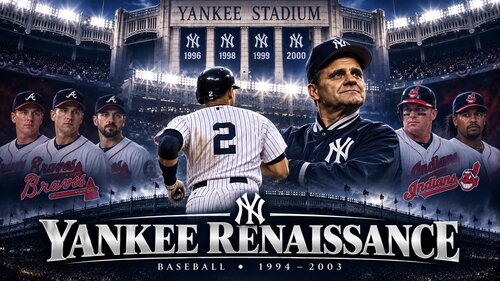
The New York Yankees had been absent for over a decade. No postseason appearances since 1981 and several recent years of genuinely bad baseball. 1994 marked a new era in baseball, with divisional realignment and the introduction of the wild-card. But it would also become the starting point for something more familiar—the return of the sport’s most storied franchise.
OUT OF THE WILDERNESS
The Renaissance did not begin with dominance. It began with interruption. The Yankees were managed by Buck Showalter in 1994 and they had the best record in the American League on August 12. But the strike that began that day cancelled the season and delayed the rising.
In 1995, New York got into the playoffs as a wild-card, but lost a heartbreaking Division Series. That defeat got Showalter fired, closing the prologue of the Yankee arrival story.
In the meantime, the Atlanta Braves were putting their imprint on the new era. The Braves got their breakthrough World Series title in 1995. And the Cleveland Indians were coming onto the scene with an explosive offense, winning the American League pennant. The Yankees were in the picture, but they were not the story.
A year later, in 1996, the Braves and Indians again posted the best records in their respective leagues and looked destined for a rematch. As the playoffs began, the new era seemed to be taking shape, but it wasn’t in the shape of Pinstripes. At least not yet.
THE DYNASTY TAKES HOLD
Two major figures arrived in New York for 1996. Joe Torre took over as manager, and a rookie shortstop named Derek Jeter arrived. Jeter would become the most visible member of the Yankees’ “Core Four,” a homegrown nucleus that included pitcher Andy Pettitte, catcher Jorge Posada and closer Mariano Rivera. Alongside them was centerfielder Bernie Williams, another homegrown star whose presence was central to the Yankees’ rise
The Yankees won the AL East. When Cleveland was upset in the Division Series, New York took advantage and reached the World Series.
When they lost the first two games to Atlanta decisively at home, it looked like the Braves were poised to solidify a dynasty. Then the Series—and, as it turned out, a decade of baseball history—changed.
New York won Game 3. They pulled off a stunning comeback to win Game 4. In Game 5, Pettitte won a classic pitcher’s duel against John Smoltz. The Yankees came home to the Bronx and completed an improbable championship run in Game 6.
After losing a tough playoff series to Cleveland in 1997, New York came back with a vengeance in 1998.
This was a year that really put baseball back on the national map after the strike of ’94. The home run exploits of Mark McGwire and Sammy Sosa captivated the nation as they chased the single-season record. And the Yankees just kept winning…and winning…and winning. They didn’t stop until they had 114 regular season wins.
In later years, McGwire and Sosa’s achievements would be clouded by revelations of performance-enhancing drug use. The Yankees’ dominance, by contrast, has remained intact. And they sealed it by coasting through October virtually unchallenged to win another World Series, completing one of the most dominant baseball seasons in history.
THE CENTER OF THE SPORT
The 1999 World Series promised to be a showdown. The Yankees were facing the Braves and the Fall Classic was billed as one that would decide the decade’s defining team.
But this was no epic showdown. New York seemed to get every key hit, and while the games individually were good, the Series was not—a four-game sweep for the men in Pinstripes.
A “Subway Series” had been the enduring dream of New York baseball—common in the 1950s when the Yankees, Dodgers, and Giants ruled the city, but absent since the Mets’ arrival in 1962. In 2000, the city finally got its modern edition.
The Series had some dramatic moments—including an extra-inning thriller in Game 1 and a volatile confrontation between Met catcher Mike Piazza and Yankee pitcher Roger Clemens in Game 2. But for all the drama within individual games, there wasn’t much suspense about who controlled the Series. It was Yankees in five.
They had won three straight championships—the first team to do so since the Oakland A’s of the early 1970s—and four in five years. The Yankees were no longer just champions. They were the center of the sport. And in a new era, they were a global brand.
CRACKS IN THE ARMOR
New York remained near the center of the sun from 2001-03, but the façade of invincibility started cracking. It began in the 2001 World Series against the Arizona Diamondbacks.
The ’01 Series was an emotional time for America, coming off the horrors of 9/11. And the Yankees, as a visible representative of New York, for perhaps the only time in their history were seen not as villains but as the torch-bearers for a hurting city.
An outstanding World Series followed. Diamondback pitchers Curt Schilling and Randy Johnson were dominant, but the Yankees found ways to scrape out some late wins against the Arizona bullpen and clung to a ninth-inning lead in Game 7. Rivera was on the mound. A fourth straight title was there for the taking.
But this time, it was a Yankee opponent that found a way to get the key hits. The Diamondbacks pushed over a couple runs and broke New York’s run of World Series crowns. In 2002, they won the AL East again, but their string of American League pennants ended in the playoffs.
2003 saw a classic showdown in the American League Championship Series. The Yankees faced their ancient rival, the Boston Red Sox and the ALCS came down to a Game 7 in the Bronx. New York sent Clemens to the mound. Boston countered with Pedro Martinez. It was everything a baseball fan could want.
And the game delivered. The Red Sox led 5-2 in the eighth inning, but the Yankees rallied for three runs to tie it, and then won it in extras on a walkoff from Aaron Boone. New York no longer dominated—but they could still survive.
The youthful Florida Marlins appeared overmatched in the World Series. But after taking a 2-1 series lead, New York faltered. They lost three straight, the last one on their homefield and it was the Marlins who celebrated.
The Yankees were still at the center of the sport—a massive global brand, constantly in the playoffs and regularly in the World Series. But they were losing their grip at the top. And 2003 had shown that their ancient rival was coming, and the balance of power was about to tip.
EPILOGUE: A LAST ECHO
By 2009, New York was coming off eight straight years without a World Series title—the only standard that mattered to owner George Steinbrenner.
While Torre continued to make the playoffs, the losses in October led to the franchise moving on after 2007. Joe Girardi was brought in, but the team missed the playoffs entirely in 2008—the first time in the wild-card era this had happened.
The Core Four was still present, strengthened by a series of high-profile free agent acquisitions. A new version of Yankee Stadium was opened. New personnel, a new Stadium, and Steinbrenner’s health failing, turned 2009 into a special season in the Bronx.
With the mix of new players and the icons of the Dynasty era, the Yankees returned to the top. The title of 2009 was not a permanent return. The landscape of the sport had changed.
It was not a return to dominance, but an echo of it.