
READ MORE ABOUT THE 1981 COLLEGE FOOTBALL SEASON
READ MORE ABOUT THE 1982 COLLEGE FOOTBALL SEASON
READ MORE ABOUT THE 1983 COLLEGE FOOTBALL SEASON
READ MORE ABOUT THE 1984 COLLEGE FOOTBALL SEASON
READ MORE ABOUT THE 1985 COLLEGE FOOTBALL SEASON
READ MORE ABOUT THE 1986 COLLEGE FOOTBALL SEASON
READ MORE ABOUT THE 1987 COLLEGE FOOTBALL SEASON
READ MORE ABOUT THE 1988 COLLEGE FOOTBALL SEASON
READ MORE ABOUT THE 1989 COLLEGE FOOTBALL SEASON
READ MORE ABOUT THE 1990 COLLEGE FOOTBALL SEASON
READ MORE ABOUT THE 1991 COLLEGE FOOTBALL SEASON
READ MORE ABOUT THE 1992 COLLEGE FOOTBALL SEASON
READ MORE ABOUT THE 1993 COLLEGE FOOTBALL SEASON
Independents certainly weren’t new to college football by 1981. Notre Dame was one of the game’s flagship programs. Penn State was a perennial contender and even Pitt had their moment. But the center of gravity still rested with major conferences and their tie-ins to traditional bowl games. The Big Ten and Pac-10 fed the Rose. The Big Eight sent its champion to the Orange Bowl. The SEC was locked in to the Sugar and the old SWC went to the Cotton. That was the heart of college football.
The 13 seasons from 1981-93 changed all of that.
It began with rumblings. The Clemson Tigers, from an ACC that was then seen as a second-tier conference with no automatic bowl invite, jumped up and won it all in 1981. Joe Paterno and Penn State got their long-awaited breakthrough in ’82.
Those were the rumblings. Then came the earthquake.
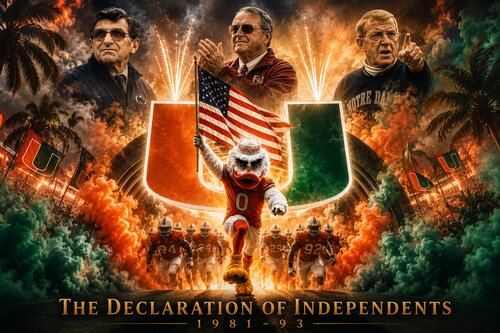
WHEN MIAMI CHANGED THE GAME
Nothing about 1983 suggested a year of seismic change. Nebraska was barrelling along, undefeated, ranked #1 and going to the Orange Bowl looking to validate their standing as one of the great teams of all-time. Texas and their smothering defense was in the Cotton Bowl, hoping the Cornhuskers stumbled.
The University of Miami was barely on anyone’s radar. But on January 2, 1983, after Texas was upset early in the afternoon, the Hurricanes shocked the world and beat the Cornhuskers in a dramatic 31-30 finish. Miami was national champs.
What’s more, this was no one-off upset. The Hurricane program defined college football for the next decade. Coaches came and went, from Howard Schnellenberger to Jimmy Johnson to Dennis Erickson. Hall of Fame talent came churning out of Coral Gables. And so did a whole lot of swagger.
Miami became more than an excellent college football team, even more than a dynasty. They became a cultural flashpoint that transcended sports. You loved them or you hated them. They won national championships in 1987, 1989 and 1991. And even when they didn’t win, they were also somewhere near the summit.
COLLEGE FOOTBALL CULTURE WARS
The Hurricanes were a steamroller in 1986, with names like Vinny Testaverde, Michael Irvin, Jerome Brown and Bennie Blades, all coached by Johnson. They were seen as unbeatable. Penn State was the team that would get the chance.
Or would they? Both the ‘Canes and Nittany Lions were independents. All of the major bowls were obligated to take at least one conference champion. The opportunity was there for a new bowl to make a splash.
It was the Fiesta who stepped up with the winning bid—highlighted by moving their game off New Year’s Day to the following night, where it would get exclusive coverage. This wasn’t the first 1 vs. 2 battle in a bowl game. It was the first time it was separated from the other bowls, with a Super Bowl feel to it.
And what a game it was. Penn State shocked the world, pulling a 14-10 upset, punctuated by an interception on the goal line. In the short-term, Paterno was a legend, and the culture war that surrounded Miami football was further inflamed. In the long-term, the Fiesta Bowl was now a player and the concept of a championship game separated from the bowls had taken root.
The culture wars around Miami escalated even more in 1988. Lou Holtz had revived Notre Dame after some doldrums early in the decade and now had the Irish back in the national championship conversation. In mid-October, they hosted the #1 Hurricanes. Notre Dame fans, still steaming over recent routs at Miami’s hands, went right at their rogue reputation. T-shirts saying “Catholics vs. Convicts” were distributed around campus and became a national sensation.
And just like the ’86 Fiesta Bowl, the ’88 Notre Dame-Miami tensions were followed by an amazing football game, with the Irish holding off a final Hurricane charge to win 31-30. Notre Dame won the national title and the rivalry with Miami continued to burn for two more years until the series was discontinued.
THE SUNSHINE STATE FRONTIER
Florida State was still an independent themselves and Bobby Bowden had the Seminoles rising by 1987. Combined with Miami, and later to be joined by Steve Spurrier’s Florida in the early 1990s, this was all part and parcel of the entire state’s emergence as a dominant force in college football.
From 1987 to 1993, the rivalry between the Seminoles and Hurricanes burned as white hot as any in sports. The culture war dynamic wasn’t present, but with FSU rolling out high-powered offenses and names like Deion Sanders and Derrick Brooks coming off the assembly line, FSU was hungry for a national title.
But getting over their in-state rival down south was more than a little problematic. A missed extra point cost Florida State against Miami in 1987—a year the Seminoles finished #2 in the final polls. In 1991, a last-second field goal went Wide Right—capitalization intended, as this too become a marketing slogan. A year later, it was Wide Right II. Florida State could do everything against Miami—except make the critical kick.
Finally, in 1993, fate smiled in Bowden. He beat Miami. A late-season loss to Notre Dame appeared to derail the championship train, but a series of upsets gave Florida State another chance. In the Orange Bowl against Nebraska, they got a chance for a late field goal—and made it. The final vote was hotly disputed by Holtz and the Irish, but it went Bowden’s way.
This 1993 validation came on Florida State’s second year in the ACC. It was the same year Penn State joined the Big Ten. The winds were shifting back toward the major conferences. But for 13 years, college football enjoyed an era of independents.