
The first half of the 1970s had produced a succession of powers—the Oakland A’s, Cincinnati Reds, Pittsburgh Pirates, and Baltimore Orioles. By 1976, however, baseball’s competitive map was changing. Free agency accelerated the movement, while the natural course of roster turnover opened opportunities for a new collection of contenders. Some established powers remained competitive, but others were being displaced at the top.
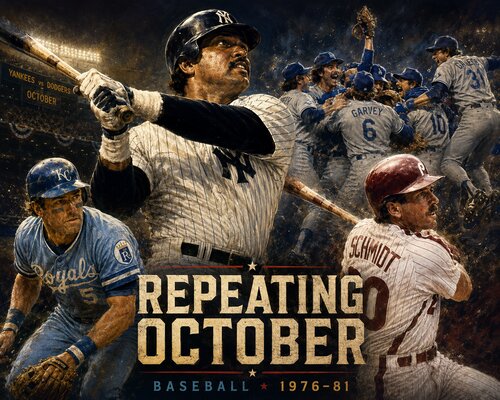
The pivot began in the American League in 1976 when the New York Yankees and Kansas City Royals reached the ALCS. Their dramatic series, concluding with a walkoff home run in the decisive game, signaled the start of a shift in the order, even as Cincinnati still closed out their dynasty in the World Series.
By 1977 the new era was apparent. Reggie Jackson joined a Yankee lineup already fortified by Catfish Hunter. Boston, with a potent lineup covering up for problematic pitching, re-emerged as a foil to New York in the AL East. Kansas City consolidated control in the AL West behind George Brett.
In the National League, Mike Schmidt and Steve Carlton pushed the Philadelphia Phillies past Pittsburgh in the NL East. And in the NL West, the Los Angeles Dodgers’ infield of Steve Garvey, Davey Lopes, Bill Russell, and Ron Cey symbolized continuity as the perennial contenders took over for Cincinnati.
The early 1970s had been marked by the best teams taking their turns at the top. This new era was different—this time, the same teams kept coming out on top, at the division, LCS and World Series level.
To wit:
*The Yankees and Red Sox fought down to the wire in the AL East, but New York won each time, even when it took a historic comeback and epic one-game tiebreaker playoff in 1978.
*The Yankees and Royals staged one of the most competitive ALCS rivalries the sport has ever known—their 1976-78 run remain the only time in either league that the same teams played three straight years. New York won all three.
*The Dodgers and Phillies played some competitive games in the NLCS, including a Game 3 in 1977 that lives in lore. Remembered as “Black Friday” in Philadelphia, it underscores the two-year rivalry—Los Angeles kept pulling it out.
*And in the World Series, New York kept getting the upper hand on Los Angeles. Whether it was Reggie Jackson hitting three home runs on three consecutive swings in ’77, or Graig Nettles pulling rabbits out of his hat defensively in ’78, it was always the Yankees getting what they needed to survive and win repeat titles.
Thus, the era that initiated in 1976 and came full bloom in 1977-78 was both competitive and repetitive all at once. But redemption was coming.
EPILOGUE: FINISHING THE JOB (1980–81)
Philadelphia and Los Angeles converted those years of frustration into championships. Kansas City finally won a pennant and did it by defeating the Yankees. The Royals-Phillies World Series of 1980 captured one breakthrough and the Dodgers defeating the Yankees in the 1981 World Series captured another.
In the meantime, teams like Houston, Montreal, and Milwaukee were announcing themselves. A new era was being unlocked.