
The introduction of the four-team College Football Playoff in 2014 created the biggest structural change to the sport in two decades. Yet while the postseason format was new, the programs at the top looked strikingly familiar. Alabama was ranked #1 going into the Playoff. Ohio State was sitting at #4 and the Buckeyes made the first splash.
Injuries forced a third-string quarterback, Cardale Jones, to be thrust into duty at the end of the season. Over the Big Ten Championship Game and two playoff victories, the Buckeyes scored an astonishing 143 points. A team that would have reached the old bowl/BCS system out of title contention had taken advantage of the first multi-round playoff.
But the fundamental source of power had not changed. The playoff had altered the path to a championship, not the geography of the sport. The SEC still ruled the roost and they were about to be joined by another power from the South.
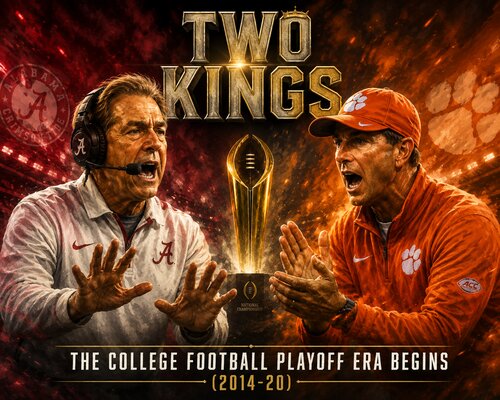
RIVALRY AT THE SUMMIT
Going two years without a national championship at Alabama in the Saban era qualified as a major drought. But make no mistake, any conversation about college football still opened with the Crimson Tide. They were back for more, but we were entering an era that would produce the first great Playoff rivalry.
Dabo Swinney had Clemson on the rise and it was the Tigers who challenged the Tide in the 2015 title game. An entertaining back-and-forth shootout ensued, and it took some special teams magic for ‘Bama to bring the championship back to Tuscaloosa in a 45-40 finish.
A year later, Clemson and Alabama were back. The Tide went into the fourth quarter with a ten-point lead. This was looking less like a rivalry and more like a confirmation of the existing order. Clemson was clearly the sport’s second-best program, but Alabama still stood alone at the top.
Until the final quarter in Tampa.
The Tigers spent that quarter making it clear that college football’s hierarchy would now need to accommodate co-kings. DeShaun Watson made himself a Clemson legend, leading three touchdown drives, that latter ending in the final ten seconds, to pull out a 35-31 win.
The next two years validated both that Alabama and Clemson were a cut above the rest of the nation, and that they stood toe-to-toe. They played in the semifinals of 2017, and the Tide won comfortably. A rematch in 2018’s title game went decisively to the Tigers.
For four years, it was a rivalry as great as any in sports.
FINAL STANDS
Clemson pushed hard for a repeat in 2019, with Trevor Lawrence leading a semifinal upset of Ohio State. But LSU, who had dethroned Alabama in the SEC, did the same against the Tigers for the championship. With Joe Burrow leading a historically explosive offense, LSU completed a great display of single-season dominance.
Ohio State took a measure of revenge against Clemson in the 2020 semifinals, but Alabama was back, and the Tide had one more title left in them for Saban. Playing through a season marked by disruption amidst COVID-19 lockdowns and fan participation sharply limited, Alabama captured Saban’s sixth national championship.
It was a fitting final championship for an era defined by Alabama and Clemson.
Beyond the Frame (2021-23)
Our historical era typically ends in 2020, but college football went through three important transition years. Kirby Smart’s Georgia displaced Alabama at the top of the SEC and won two straight national championships. Even more important, the structure of college football was undergoing some of the most dramatic changes since its inception, changes that would come to fruition by 2024.
An expansion of the postseason to 12 teams for the 2024 season drastically altered the pursuit of the national championship. Issues like NIL (Name-Image-Likeness) and player movement transformed the sport’s economics and created roster turnover that would have been unimaginable only a few years earlier.
As college football looked ahead to an uncertain future, Michigan’s national championship in 2023 signaled that a shift in the geographic balance of power might again be underway.