
By the late 1980s, the NCAA Tournament had become one of the defining events on the American sports calendar. The coaches and programs that had built March Madness were still formidable, but a new generation was beginning to take control.
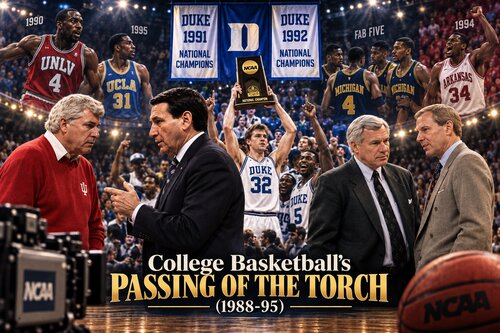
The transformation was gradual at first. Bob Knight and Dean Smith, two of the defining coaches of the previous era, remained squarely in the championship picture. Knight won multiple Big Ten titles, made another Final Four and was on pace to make another before a late-season injury altered the trajectory. Smith won his second national championship in 1993, elevating his standing in history.
Elsewhere, Jerry Tarkanian secured his vindication at UNLV with a dominant national championship run in 1990. And UCLA enjoyed a revival, with Ed O’Bannon leading the way in 1995 as the Bruins won their first crown since the Wooden Era.
But change was afoot and new names were rising. Michigan’s “Fab Five” became a cultural flashpoint—five freshmen who broke convention with their baggy shorts and brash style. Led by Chris Webber and Jalen Rose, the Fab Five made history by reaching the NCAA final as freshmen and doing it again as sophomores.
Nolan Richardson unleashed “Forty Minutes of Hell” at Arkansas, winning the 1994 national championship and getting to the title game a year later. Rick Pitino modernized Kentucky with his aggressive full-court pressure and three-point shooting and started knocking on the door.
Another historical transition was seen at Kansas. Roy Williams, a longtime assistant to Dean at North Carolina, got an opportunity to come to Lawrence and take over a Jayhawk program that won the 1988 national championship behind an epic Danny Manning performance. Williams retooled for the post-Manning era, beat Dean in a Final Four game in 1991 and announced his own arrival.
At the center of the transition is the man with the long Polish last name in Durham.
Mike Krzyzewski had already made his first Final Four, in 1986, when this era began. Over these eight years, he made six more. He got a breakthrough title in 1991 with a dramatic upset of undefeated UNLV followed by a title-game win over Williams and Kansas.
And in 1992, Duke not only became the first repeat champion since Wooden’s UCLA, they did it in symbolic fashion. Their Final Four victory over Indiana functioned as a passing of the torch—from Knight to Coach K—as the defining figure in the sport.