
The 1992 season marked the beginning of a new chapter in NFL history. Like the rise of the San Francisco 49ers a decade earlier, the change began in an NFC Championship Game between Dallas and San Francisco. This time, the Cowboys emerged as the new power.
The 49ers, however, remained elite. In fact, for four seasons, the NFL belonged almost exclusively to these two franchises.
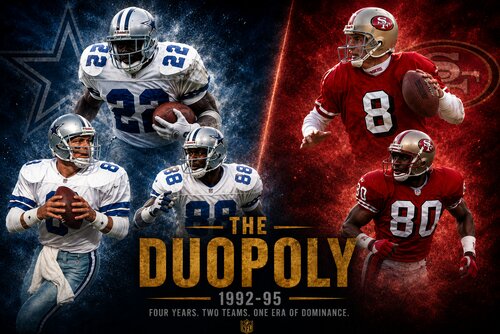
POWER TAKES HOLD
After fading in the latter part of the 1980s, Dallas changed ownership. Jerry Jones took over and he hired Jimmy Johnson, fresh off dominating the college football landscape at the University of Miami. By 1992, an aggressive rebuilding program was coming to fruition. The Cowboys had a “Big Three” of quarterback Troy Aikman, running back Emmitt Smith and wide receiver Michael Irivin. And one of the great offensive lines of all-time.
San Francisco, having already made a seamless transition at head coach to end the previous era, now did the same at quarterback as Steve Young took over from Joe Montana. Young promptly won a couple of MVP awards and the 49er Dynasty rolled on in a new form.
For four seasons, from 1992-95, Dallas and San Francisco were the signature franchises. It’s not enough to say that these two teams combined to win each Super Bowl in that period, or even that they played in three NFC Championship Games. It’s also that they were clearly perceived, accurately, as head and shoulders above the rest of the NFL. They weren’t on precisely equal footing—the Cowboys won three titles to one for the 49ers. But together, they defined the era.
FREE AGENCY & THE BALANCE OF POWER
The Duopoly era also coincided with one of the biggest structural changes in NFL history. Free agency arrived, permanently changing roster construction and the balance of power throughout the league. And that was underscored by how Dallas and San Francisco were impacted by the league’s signature free agent.
The Cowboys had a leg up on the 49ers in 1992 and 1993. San Francisco was losing ground, and the main reason was defense. Deion Sanders, the cornerback who could lock down in coverage, return punts, play a little wide receiver, and do it all with an electric flair, hit the market.
San Francisco opened the vault. And in 1994, Deion changed the balance of power. The 49ers got their revenge on the Cowboys and won the Super Bowl.
Jerry Jones didn’t take it lying down. Deion had only signed a one-year deal, so Dallas returned the favor. A big-money deal got Sanders to Texas. And the Cowboys sealed their status as senior partner of the Duopoly by winning a third Super Bowl in four years.
AMERICA’S TEAM: FOR BETTER OR WORSE
Before you take this landscape to presume stability—maybe even a little boredom—think again. These franchises, particularly Dallas, were anything but boring. Jones was colorful and controversial in a way no NFL owner outside of Raider boss Al Davis had been. Johnson was no less a magnet for hot emotions on both sides.
Perhaps it was inevitable that the two personalities would clash. It came to a head in February of 1994, with Dallas fresh off their back-to-back titles when Jones fired Johnson.
Moreover, Jones hired Barry Switzer, who had won national championships at the University of Oklahoma, but never coached in the NFL, and had left Norman under a cloud of scandal. The Cowboys became an even bigger hot button for fans across the country.
BUFFALO’S FOUR-YEAR RUN
The Buffalo Bills had ended the previous era in frustration, losers of consecutive Super Bowls in 1990-91. They kept that going into this era, coming up short to Dallas in the Super Bowls that followed the 1992-93 seasons.
Although a more positive observer—such as this space—might reframe that to say they won four straight AFC Championship Games, a feat unprecedented in the Super Bowl era. Jim Kelly, Thurman Thomas, Andre Reed, and Bruce Smith never won it all, but they owned their half of the league.
A CHANGING OF THE GUARD
Joe Montana resurfaced in Kansas City and had two productive years before retiring following the 1994 season. A year later, the legendary Miami Dolphins head coach Don Shula, with more wins than any coach in league history, followed suit.
As Montana and Shula said goodbye, Brett Favre was saying hello in Green Bay.
The Packers were back on the map for the first time since the Lombardi Era. Favre was joined by another big free agent—the great defensive tackle Reggie White. The young quarterback won the MVP award in 1995. His team’s upset win over the 49ers in that year’s Divisional Playoffs signaled that a new era was about to begin.