
Michael Jordan was an electric star in the NBA from the moment he was drafted by the Chicago Bulls in 1984. His high-flying style made for great photography, especially with his signature habit of his tongue hanging out mid-jump. The “Air Jordan” shoes were a craze by 1985, Jordan was a scoring champion by 1987, and he won his first MVP award in 1988.
There was one thing, however, that Michael Jordan was not by the time 1991 rolled around, and that was a champion.
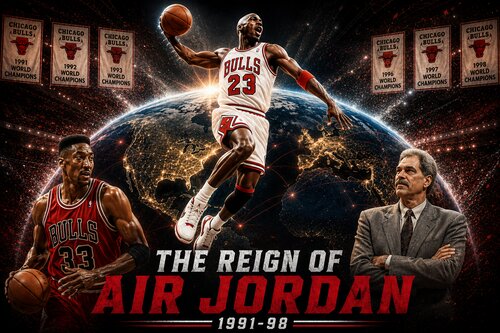
Jordan’s quest for his breakthrough title was an obvious storyline in the league. Less remembered—perhaps because few from this era will admit to pushing the point of view—is that there was real speculation that Jordan simply wasn’t a winner.
Under this theory, Jordan was a spectacular talent and fun to watch, but not someone like a Magic Johnson or Larry Bird that could lead a team to a title.
In the 1990s, Michael Jeffrey Jordan took their theory, tossed it into the shredder.
He not only secured one of the great individual legacies in the history of sports, he lifted an entire league and made it global.
Under head coach Phil Jackson, the Bulls embraced a system that balanced Jordan’s brilliance with a cohesive team structure, while Scottie Pippen emerged as the superstar running mate Jordan had previously lacked.
1991 was the Changing of the Guard year.
Jordan’s Bulls met their nemesis, the Bad Boy Detroit Pistons in the Eastern Conference Finals for the third straight year. Chicago swept the series. In the Finals, Michael took on Magic, who was still leading the Los Angeles Lakers. After spotting L.A. the first game, the Bulls ripped off four straight wins. Jordan was a champion.
A year later, Chicago was back in the Finals against the Portland Trail Blazers. Jordan came out in Game 1 and bagged six three-point shots, debunking the idea that the perimeter game was his weakness. After one of them, Jordan turned to the broadcast table where the now-retired Magic was sitting and just shrugged his shoulders. Chicago won that series in six games.
Jordan spent the summer of 1992 in Barcelona. The Summer Olympics were historic—it was the first time pro players would play basketball for the United States. The “Dream Team” was an iconic cast of talent, but Michael was their central figure. They brought home the gold medal in devastating fashion and the NBA’s global marketing efforts took off.
In 1993, the Bulls paced themselves through the regular season. Jordan and Pippen had logged a lot of miles, between two straight championship runs and an Olympic trip. They saved their energy for the postseason. In the Eastern Conference Finals, against Patrick Ewing’s New York Knicks, Chicago rallied from a 2-0 deficit to win four straight. In the Finals, Jordan met Charles Barkley and the Phoenix Suns. The Bulls’ six-game triumph was culminated when John Paxson bagged a three-point shot in the closing seconds of the finale.
Jordan, Pippen, and the entire city of Chicago were riding high. Then, in the blink of an eye, it was gone. Jordan’s father, James, was murdered during the summer of 1993, and that October Michael stunned the world by retiring from basketball at age 30. Jordan said he had lost the desire to play and soon pursued a new challenge, playing minor league baseball in the Chicago White Sox organization.
But his well-documented gambling had already generated controversy, and the abrupt retirement also produced persistent speculation that he was serving a quiet NBA suspension. That theory has never been established as fact, and Jordan and the league have denied it. Whether there was more behind his departure than the public explanation remains the subject of legitimate historical debate.
In the spring of ’95, Jordan sent out a simple fax—“I’m back.” He returned for that year’s postseason, although it was too late to help the Bulls against the Orlando Magic and a rising star named Shaquille O’Neal. But with a full offseason to get ready, Jordan was ready to end the decade the same way he started it.
Chicago brought the enigmatic Dennis Rodman into the fold, who provided tabloid attention along with his excellent defense and rebounding. The ’96 Bulls rewrote the record book, with a league record 72 regular season wins. They rolled through the postseason to a championship that felt more like a coronation.
The final two seasons of this era were marked by battles with the Utah Jazz. With a Hall of Fame combo of point guard John Stockton and power forward Karl Malone, the Jazz were the worthy foil that every protagonist in a story needs. The Chicago-Utah Finals battles of 1997 and 1998 were both rich in plot lines.
Those Finals produced the “Flu Game,” where Jordan first suffered food poisoning from what he and the Bulls alleged was a deliberately tainted pizza sent to his Salt Lake City hotel room. Jordan played through the sickness to win a road Game 5 that broke a series tie and set up another Bulls’ title, this one secured when Steve Kerr hit the late shot in Game 6.
In 1998, now old warriors, Jordan and Pippen held off a determined Indiana Pacers team led by Reggie Miller to get back to a Finals rematch. Against Utah, Jordan delivered his final masterpiece. In Game 6 on the road, he seized control in the closing moments—hitting one shot, forcing a turnover, and then hitting the decisive jumper that ended the series and the era.
One three-peat championship run is history-making. Doing the same thing twice, while mixing in a historic Olympic performance and a mysterious hiatus? Jordan defined the decade, elevated the NBA, and reshaped the role of sports in American culture.