
College football was changing, but the map of power was not. A concentrated group of programs remained at the top and the names had not fundamentally changed from the latter part of the 1960s and early years of the 1970s. The sport was defined by prominent rivalry games that consistently had high national and regional stakes:
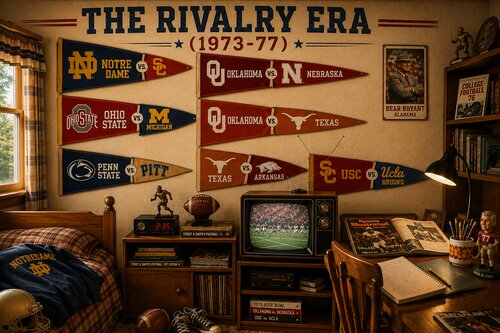
Oklahoma / Nebraska: The Big Eight Axis
These two schools had played a historic game on Thanksgiving Day 1971 and both were in transition, as Barry Switzer took over Oklahoma and Tom Osborne was elevated at Nebraska in 1973. It formed the foundation of a new era and the Sooners began to get the upper hand. OU won national titles in 1974 and 1975.
Notre Dame/USC: The Cross-Country Grudge Game
The Irish and Trojans were consistently in the race for the national championship and their game—either mid-October in South Bend or the season finale in Los Angeles—carried major national stakes. Notre Dame won a national title in 1973 under Ara Parseghian and then got another one in 1977 with Dan Devine coaching and Joe Montana at quarterback. USC’s legendary John McKay, fresh off winning the title in ’72, kept churning out great running backs and Rose Bowl teams until he went on to the NFL and handed the reins to John Robinson.
Michigan / Ohio State: The Ten-Year War
Bo Schembechler and Woody Hayes define the northern spine of the era. The Big Ten race and its Rose Bowl bid consistently comes down this rivalry game. Woody has the upper hand in the early part of this era, with two-time Heisman winner Archie Griffin. But as the 1970s moves into the second half, the balance of power starts shifting to Bo. To the consternation of the entire Midwest though, the most steady constant is Rose Bowl losses—including an upset loss to UCLA in 1975 that cost the Buckeyes a national championship.
Other familiar faces include:
Texas: The Longhorns, who had their own annual rivalry game with Oklahoma every October, transitioned from the legendary Darrell Royal to Fred Akers at head coach. In 1977, Texas soared to the top of the polls behind the great running back Earl Campbell. A loss to Notre Dame ended that bid, but Texas was consistently at or near the top of the old Southwest Conference, where they did regular battle with Arkansas.
Penn State: The Nittany Lions were going through considerable frustration. 1973 marked the third time in six years they went undefeated but uncrowned in the polls. They made major bowl games and won them, produced a Heisman Trophy winner in John Cappelletti and sent a slew of great players to the pros. But not only did Joe Paterno not get the ultimate validation, he had to watch as cross-state rival Pitt did—the Panthers, led by Tony Dorsett, were beginning the best years of their program history in the mid-1970s and they won a national championship in 1976.
Alabama: Going back to 1966, no team had knocked on the door of the top without getting in as consistently as Alabama. An undefeated team in ’66 was unrewarded at the polls. In both 1973 and 1974 they lost heartbreaking bowl games that would have resulted in at least a share of the national championship. In 1977, they finished #2 in a close vote. Ironically—or maddeningly if you were a Tide fan—all four of those heartbreaks came at the hands of Notre Dame, either on the field or in the voting.
The sport’s modern framework was taking shape. Oklahoma was asserting themselves. Notre Dame was capitalizing on their chances. Alabama continued to fall just short. But the Tide’s time was coming.