
Season-by-season overviews from the Small Markets Era:
1970 MLB Season Overview
1971 MLB Season Overview
1972 MLB Season Overview
1973 MLB Season Overview
1974 MLB Season Overview
1975 MLB Season Overview
1976 MLB Season Overview
During these seven seasons, the Oakland Athletics, Cincinnati Reds, Pittsburgh Pirates, and Baltimore Orioles combined to win every World Series championship from 1970 through 1976. No other period of the divisional play era has seen four franchises dominate October so completely.
For most Major League Baseball history, the league has been dominated by big markets, primarily in New York and including Los Angeles. The period of 1970 through 1976 was unique. In the final years before free agency, four small-market teams asserted dominance.
The Oakland A’s, Cincinnati Reds, Pittsburgh Pirates and Baltimore Orioles formed the center of baseball. In an era when MLB had just four divisions and only first-place teams made the postseason, these four franchises—each in a different division—crowded everyone else out in October.
Every year during this stretch saw exactly three of the four make it to the League Championship Series. They took their turns as the odd team out. Each won at least one World Series. And the ultimate champion always came from this group.
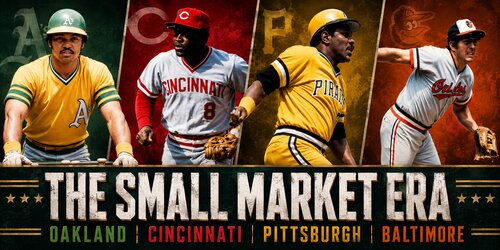
First among equals was Oakland. Known as “The Mustache Gang” for their flouting of baseball’s traditional clean-shaven customs, the A’s won five straight AL West titles and three straight World Series titles. The lineup was anchored by Reggie Jackson and included Joe Rudi and Sal Bando. A dominant pitching staff had Catfish Hunter and Vida Blue in the rotation and the great Rollie Fingers on the back end. Oakland remains the only franchise other than the New York Yankees to “three-peat” in the Fall Classic.
The Big Red Machine in Cincinnati steamrolled offenses. Johnny Bench won two MVP awards, dominated defensively and was one of the great catchers of all-time. Pete Rose churned out hits and won an MVP of his own. Prior to 1972, Joe Morgan was acquired and he won the MVP twice. Manager Sparky Anderson became known as “Captain Hook” for his more modern use of bullpens. The Reds dealt with disappointments—painful October losses in 1970, 1972 and 1973. But they got vindication with a dramatic title in 1975 and validation as a dynasty with a repeat crown in ’76.
Fans in Pittsburgh cheered on the last years of the great Roberto Clemente, who delivered the Pirates a World Series crown in 1971 and nearly got there again a year later before his tragic death flying a humanitarian mission to Puerto Rico. Willie Stargell was in his prime, and as the decade reached its midpoint, Dave Parker was starting to emerge. Steve Blass led the pitching staff and was a World Series hero in ’71.
No team has dominated its division or the American League the way Earl Weaver’s Baltimore Orioles did in the early years of this era. They went 9-0 in a then best-of-five ALCS round from 1969 through 1971 and won the World Series in 1970. These Birds were renowned for the pitching staff, led by Jim Palmer. Four 20-game winners in 1971 is an accomplishment unlikely to be duplicated, given the changes in how pitching staffs are managed today. The Orioles had great offensive talent, from Boog Powell to Brooks Robinson to Frank Robinson, and more.
HOW FREE AGENCY CHANGED BASEBALL
Simmering underneath this small market excellence were the labor tensions that would soon change the sport. A lockout delayed the start of the 1972 season. Legal cases involving Curt Flood and Andy Messersmith eventually opened the door to free agency and the balance of power shifted.
The A’s were unable to survive the shift, and virtually all of their key players were gone by the second half of the decade. The Reds, Pirates, and Orioles remained competitive, albeit short of the postseason. The World Series became the province of the big markets again, with the Yankees and Los Angeles Dodgers rising to the top.
ONE LAST RUN
We call 1979 “The Bookend Season” when the band got back together one last time to close the decade. Cincy, Pittsburgh, and Baltimore all won their divisions again. The Pirates and Orioles reached the World Series. Just like in 1971, Pittsburgh survived Baltimore in an outstanding seven-game Fall Classic. Stargell, now known as “Pops” woke up the echoes one last time in a decade that ended as it had begun.
The big market powers weren’t going away. New York and Los Angeles would soon reassert themselves. Other young teams were rising, from Houston to Montreal to Milwaukee. All of this would shape the seasons immediately ahead. But the first part of the 1970s—and one last run at the decade’s conclusion—belonged to the small markets.
LEARN MORE
You can read the season-long overviews of Major League Baseball from 1970 through 1976. Individual team articles are linked within them. You can read not just about the four franchises highlighted here, but those that challenged them, and the teams that took their own turns and sneaked onto the October stage.