
From 2008 through 2017, the NHL saw a revival of franchises from hockey’s traditional cold-weather strongholds, from Original Six powers to more modern teams. The league had expanded geographically and embraced the salary-cap era, but some familiar hockey markets were about to reassert themselves.
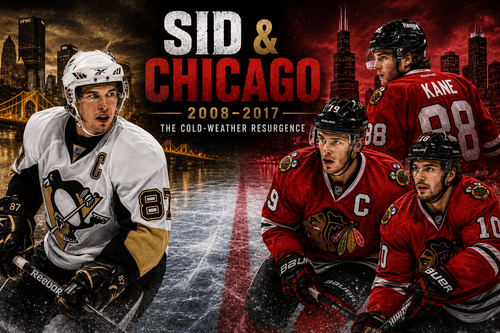
It started with a heated rivalry between Detroit and Pittsburgh.
The Red Wings, still powered by future Hall of Famers like Nicklas Lidstrom and Pavel Datsyuk and juiced by the scoring of Henrik Zetterberg, returned to the Finals in 2008. The Penguins had two of the most dynamic young players in the sport, with Sidney Crosby and Evgeni Malkin. Pittsburgh enjoyed a breakthrough season and reached their first Finals since the days of Lemieux in the early 1990s.
Detroit won a hard-fought six-game series to hoist their fourth Cup in the last twelve years. In 2009, the Red Wings and Pens were back at it. Detroit looked poised to assert their superiority again, winning the first two games and still holding a 3-2 series lead.
But over the next two games, the ships of these two franchises effectively passed in the night. Pittsburgh won Games 6 & 7 to return to the top of the NHL. They stayed at or near the center of the league’s sun for the next decade-plus. Detroit, meanwhile, began a gradual fade from relevance.
THE WINDY CITY ASCENDANT
The Chicago Blackhawks had not been truly relevant since the mid-1990s and the Windy City last saw the Stanley Cup when JFK was president. Early in 2009, the hiring of head coach Joel Quenneville sparked a turnaround and in 2010, it came full fruition.
Quenneville had a roster with exceptional young talent. The quartet of Patrick Kane, Duncan Keith, Jonathan Toews and Patrick Sharp were all in their 20s. These Blackhawks put it all together and won the Stanley Cup.
And they weren’t done. In 2013, Chicago returned to the Finals after a dominant regular season. In a hard-fought battle with Boston, the Blackhawks had a 3-2 series lead by trailed Game 6 by a goal late in the game. In one of the most stunning finishes in Stanley Cup history, Chicago scored twice in the final 1:16 to win their second Cup.
Two years later, after a crushing Game 7 overtime loss in the ’14 Western Conference Finals, the Blackhawks were back again. This time they survived a Game 7 in the conference finals. And facing a young and talented Tampa Bay Lightning team, Chicago went all the way one more time. A six-game series led to a third Stanley Cup in five years.
The Blackhawks of this era might not have gone back-to-back, but they were most certainly a dynasty.
THE WEST COAST INTERRUPTION
The Los Angeles Kings were the franchise who intervened in a stretch otherwise ruled by Snow Belt teams. In 2012, the Kings were led by Anze Kopitar and backed up in goal by Jonathan Quick and they won the Stanley Cup. What seemed like an improbable run as an 8-seed proved to be anything but. Los Angeles was able to dethrone Chicago in 2014, and win a second championship in three years.
But even the rise of the Kings still managed to showcase the cold-weather markets. Their foil in 2012 was New Jersey, with Martin Brodeur on one last ride to the Finals. In 2014, the Kings played the Rangers in the first New York-Los Angeles title clash in any sport since the 1978 World Series.
And in the years surrounding Los Angeles’ peak, the Boston Bruins were lurking. A team that played traditional, physical defense, the Bruins upset top-seeded Vancouver in the 2011 Stanley Cup Finals. Two years later, the Bruins dismantled Crosby’s Penguins en route to another Finals appearance.
Los Angeles was an excellent team in the first half of the 2010s. But even at their best, hockey’s cold-weather strongholds were never far from the public mind.
SID’S ENCORE
Pittsburgh’s recent postseason frustration, combined with injury problems for Crosby, were raising doubts over whether the brilliant player would have to settle for “only” one Stanley Cup after a career debut that seemed to promise much more. In 2016 and 2017, Crosby, along with Malkin and another great veteran, defenseman Kris Letang, put all doubts to rest.
In ’16, the Penguins came through the East by beating their archrival, the Washington Capitals, who were led by Alex Ovechkin. It took a seven-game fight with Tampa Bay to win the East. And when the Penguins dispatched the San Jose Sharks in the Cup Finals, Crosby was a two-time champion.
One year later it was more of the same. Pittsburgh squared off with Washington in the second round. It took seven games, but the Penguins beat the Caps again, the first of two seven-game battles they needed to get through the East. The drive to be the first repeat champion in nearly two decades ended with a six-game triumph over Nashville.
The last ten years had been anchored by Chicago, but it was bookended by the Penguins and Crosby.