
The NBA of the 1980s is often simplified into a single rivalry, Magic Johnson and the Los Angeles Lakers against Larry Bird’s Boston Celtics. But that narrative overlooks the fact that for the first part of the decade the Philadelphia 76ers, led by Julius “Dr. J” Erving, were not only present among the elite, they were the power of the Eastern Conference.
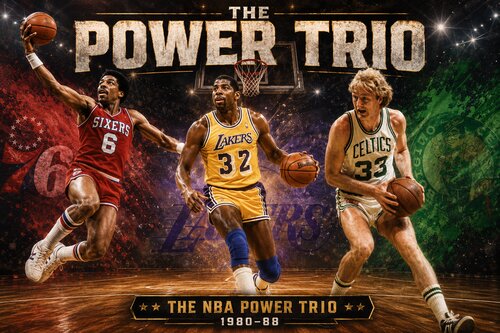
Philadelphia was the foil for Magic, Kareem Abdul-Jabbar and the Lakers in the 1980 NBA Finals, a series remembered for Kareem Abdul-Jabbar’s dominance and Magic Johnson’s famous Game 6 clincher when he jumped center and scored 42 points.
The 76ers and Lakers met again in 1982, with the same result—a Laker title in six games. Philadelphia needed a center if they were going to take the next step. In 1983, they got one. A trade brought Moses Malone to Philly and a dominant championship run, culminating with some sweet revenge against Los Angeles was a long-sought coronation for the franchise.
Boston may have been a step behind Philadelphia in the decade’s early years, but the Celtics still had their moments. The biggest one came in 1981. Trailing the Sixers 3-1 in the Eastern Conference Finals, Boston won three in a row, all by a single bucket and went on to win the title.
1984 began a four-year stretch that the decade is remembered for. The Celtics and Lakers meet in the Finals and Boston wins an exciting seven-game series. They rematch in 1985, with Los Angeles getting a championship that was not only short-term revenge, but long-term catharsis—it their first triumph over the Celtics in nine Finals meetings, and the clincher came on the old parquet floor.
The coastal rivals were now clearly ascendant, with the 76ers falling back to the pack. Boston’s 1986 team was one of the NBA’s greatest of all-time, and Bird won his third consecutive MVP award. The Houston Rockets, anchored by Hakeem Olajuwon in the post, disrupted the West with an upset over L.A. in the conference finals, but no one was stopping this Celtic freight train.
Los Angeles’ postseason defeat left them at a crossroads. The league was getting bigger and conventional wisdom said the Lakers needed to follow suit. The leadership team of GM Jerry West and head coach Pat Riley decided otherwise—the Showtime Lakers would overcome bigger teams simply by outrunning them. And they did it all the way to a title in 1987, a season that included Magic’s first MVP award and ended with a Finals victory over Boston.
The power was shifting in the Eastern Conference. The Celtics had barely held off the rising Detroit Pistons in the conference finals of 1987. In 1988, they couldn’t hold back the tide, and Detroit, led by Isiah Thomas and loaded with physical players, reached the Finals. A dramatic seven-game series with Los Angeles saw the Lakers become the NBA’s first repeat champion since 1969. But with the Pistons now arrived, and a budding star in Chicago with the last name of Jordan gaining steam, the Lakers-Celtics-76ers Power Trio Era was over.
A Bad Boy Bridge (1989-90)
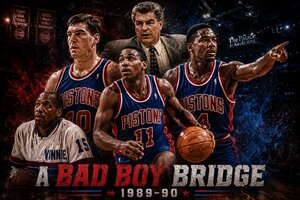
The Detroit Pistons team that overtook Bird in the East completed its rise by passing Magic in 1989. This Piston team was a group of self-professed “Bad Boys.” They had proud enforcers in Rick Mahorn and Bill Laimbeer and an athletic, relentless forward named Dennis Rodman. They made enemies around the league.
But that shouldn’t overshadow their excellence or the fact that the enforcer mindset was combined with classic basketball excellence. Isiah Thomas was the leader of the team and one of the great playmaking point guards in NBA history. Joe Dumars, a quiet assassin, was deadly on the perimeter. So was Vinnie Johnson, coming off the bench and known as “The Microwave” for his ability to heat up quickly.
Unlike the superstar-driven champions that framed their rise, Detroit’s identity was collective. Isiah was first-among-equals, but the Pistons overwhelmed opponents with depth, balance and clearly defined roles.
Chicago was clearly coming. Michael Jordan made his first big postseason splash with an iconic walkoff jumper to beat the Cleveland Cavaliers in 1989. The Cavs themselves, were a quality contender with Mark Price in the backcourt and Brad Daugherty down low. Magic and the Lakers didn’t go quietly. And Portland, led by Clyde Drexler, was a coming force in the West.
But Detroit stood in everyone’s way. Twice, they turned back Jordan in the Eastern Conference Finals. They swept Magic out of the 1989 NBA Finals and dispatched Portland in five in 1990.
This period was short enough that it was less than an era than a bridge. But without it, there is no historical transport from the Power Trio era to the global firestorm that was coming next.