
READ MORE ABOUT THE 1994 COLLEGE FOOTBALL SEASON
READ MORE ABOUT THE 1995 COLLEGE FOOTBALL SEASON
READ MORE ABOUT THE 1996 COLLEGE FOOTBALL SEASON
READ MORE ABOUT THE 1997 COLLEGE FOOTBALL SEASON
READ MORE ABOUT THE 1998 COLLEGE FOOTBALL SEASON
READ MORE ABOUT THE 1999 COLLEGE FOOTBALL SEASON
READ MORE ABOUT THE 2000 COLLEGE FOOTBALL SEASON
READ MORE ABOUT THE 2001 COLLEGE FOOTBALL SEASON
READ MORE ABOUT THE 2002 COLLEGE FOOTBALL SEASON
READ MORE ABOUT THE 2003 COLLEGE FOOTBALL SEASON
READ MORE ABOUT THE 2004 COLLEGE FOOTBALL SEASON
READ MORE ABOUT THE 2005 COLLEGE FOOTBALL SEASON
College football was reaching a tipping point in terms of perception of its national championship. The public’s willingness to tolerate ambiguity over the basic question “who is the champion” was rapidly receding, in light of split claims to national supremacy in 1990 and 1991, and heated controversy in 1989 and 1993. The conferences began working on ways to create a clear-cut 1 vs. 2 national championship game within the framework of the bowl system. That process accelerated from 1994 to 2005.
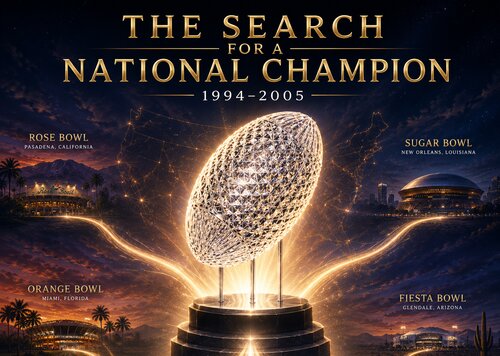
The first step was called “The Bowl Alliance” and it brought most of the major conferences together to agree that, whatever bowl their champion might be committed to, the two highest-ranked teams would play. While the Big Ten and Pac-10, in conjunction with the Rose Bowl, weren’t on board, the odds of an undisputed champion took a step forward.
By 1998, the Big Ten, Pac-10 and the Rose Bowl agreed to come into the Alliance, and it was rebranded as the Bowl Championship Series (BCS) with four bowls (Rose, Fiesta, Sugar, Orange) rotating as hosts of the 1 vs. 2 battle. While the Associated Press, the game’s most traditional poll, would not agree to automatically anoint the winner of that game #1—a resistance that would still have some consequences, college football now had its best chance for season-ending clarity.
Coincidentally, the two phases of the search for a champion happened to coincide with two distinct phases in the balance of power in college football. The 1994-97 period was marked by vindication and a dynasty. From 1998-2005, there was more balance and a shared distribution of success.
VINDICATION
The national championship pursuits of Nebraska head coach Tom Osborne were a story that transcended college football. Osborne was universally admired for his decision to go for a two-point conversion and the win in 1983 against Miami when settling for a tie in the Orange Bowl would almost certainly have given him his first championship. But the universal admiration that followed that missed two-point try gradually turned into universal tut-tutting, as Nebraska repeatedly lost big games over the ensuing decade.
In 1994, the Cornhuskers broke through and they did in the sweetest possible way. They returned to the scene of the crime—in the Orange Bowl, against Miami—and they put the Hurricanes away.
There was still controversy—Penn State, now in the Big Ten and committed to the Rose Bowl became Joe Paterno’s fourth team to be undefeated and uncrowned at season’s end. But Osborne had the biggest monkey off his back.
One year later, Nebraska did it again. Facing Florida and a high-powered offense coached by Steve Spurrier, the Cornhuskers put on a physical demolition. The 62-24 win marked the ’95 Cornhusker edition as one of the great teams of all-time.
Even the one intervening year, 1996, fit the vindication theme. Florida, after the beatdown, faced questions over whether their wide-open Fun-And-Gun offense could win the biggest games. Those questions accelerated when they lost to archrival Florida State late in the ’96 season. But a series of upsets gave the Gators another chance. They rematched with the Seminoles in the Sugar Bowl. A 52-24 revenge pounding of FSU gave Spurrier and Florida their own redemption.
In 1997, with Osborne having announced his impending retirement, Nebraska did it one more time. They went undefeated, then beat Peyton Manning’s Tennessee team in the Orange Bowl.
The shortcomings of the Bowl Alliance were still on display—Michigan went undefeated, won the Rose Bowl and ended up sharing the title with Nebraska. But there were no shortcomings in the Cornhuskers. Osborne had slammed the door on his critics with this closing surge to his career.
A BALANCE OF POWER
The next eight years saw champions come from everywhere. There were returns to prominence by Oklahoma, Texas, Miami, Ohio State, and USC, all of whom got to the throne room. There was a long-awaited breakthrough for Tennessee. And a young head coach named Nick Saban did it with LSU.
Both Miami and USC made serious bids at dynasty status, but all-time great finishes denied them. The Hurricanes, after winning in 2001, were heavily favored against Ohio State in 2002. The game went two overtimes, was marked by a controversial pass interference call, and the Buckeyes pulled the upset.
As for the Trojans, they were a beneficiary of the AP’s reticence about joining the BCS, getting the # 1 ranking in 2003 while Saban’s LSU won the BCS trophy. USC won it with no questions asked in 2004 and were poised to do it again in ’05.
Their Rose Bowl battle with Texas would become an instant classic. USC let an 11-point lead in the fourth quarter slip away, Vince Young made himself a Longhorn legend and the ‘Horns hooked the Trojans.
Starting in 2006, the BCS’ showcase 1 vs. 2 game would not be in one of the bowls but would be a separate stand-alone championship game. More important is that, after eight years of champions coming from everywhere, power was about to enter an era of major regional consolidation–one dominated overwhelmingly by the Southeastern Conference.