
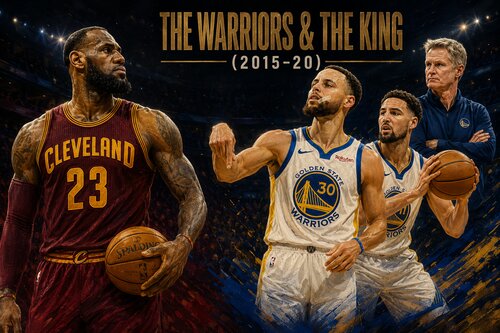
In 2015, a new NBA order started to shape on opposite sides of the country. The Golden State Warriors were emerging, with the exciting backcourt of Steph Curry and Klay Thompson. For the 2015 season, Golden State made a coaching change to try and get to the next level and hired Steve Kerr. An even more ballyhooed move prior to that season was another “Decision” by LeBron James—four years after leaving Cleveland for Miami, King James hit the free-agent market again and decided to come home. LeBron joined forces with Kyrie Irving.
It’s not enough to say the rising Warriors and the new-look LeBron Cavs defined the NBA for the next four years. They were the NBA in the seasons from 2015 through 2018. They played in the Finals each year, an unprecedented run of rematches in any major sport.
Golden State won the 2015 title and then spent most of 2016 blowing the rest of the league out. The Warriors won 73 regular season games, eclipsing the ’96 Bulls for the most all-time.
In the Western Conference Finals, they faced real danger—falling behind 3-1 in a series against the Oklahoma City Thunder of Kevin Durant and Russell Westbrook. But Golden State stormed back, won three in a row, and then took three of the first four against Cleveland in the Finals. A repeat title to validate a historic season seemed all but sealed.
Only it wasn’t. LeBron’s Cavs found a way to win the next two games and set up a Sunday Night Game 7. In one of the great NBA games ever played, LeBron came up with a huge blocked shot on a fast break late in the game, Kyrie hit a money three, and Cleveland had delivered their long-suffering sports fans a championship.
Golden State responded by signing Durant on the free agent market, integrating him into a lineup of Steph, Klay and Draymond Green. A period of inevitability followed. Golden State would win the West. Cleveland would win the East. And the Warriors would cruise past the Cavs in the Finals. While there were some other interesting teams, the league’s fundamental top-line narrative seemed cast in stone.
This era had a two-year epilogue. LeBron left Cleveland after his contract expired and went to Los Angeles. The league slowly began to open up again. The Toronto Raptors, bolstered by Kawhi Leonard, stepped into the breach in 2019. They won the Eastern Conference and then denied Golden State’s bid for a three-peat in the Finals. After a difficult first year with the Lakers, LeBron got clicking with Anthony Davis and won a championship in 2020, finishing it off in the surreal atmosphere of the COVID-inspired “bubble” of Orlando, with games played on a neutral floor without fans.
The Warriors and LeBron didn’t disappear in the new era. In fact, after a brief step back, Golden State won another championship in 2022. The Lakers continued to be a presence in the West. But the period where the Warriors and LeBron loomed over everything else gave way to something more parity-driven.