
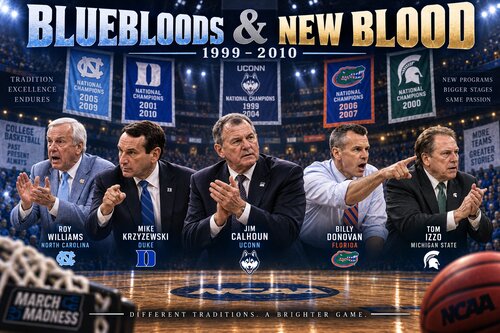
Throughout the 1990s, Jim Calhoun built UConn into a national contender that kept knocking on the door of its first Final Four in more than three decades. During the 1999 season, the Huskies, along with Duke, operated on a level above the rest of the country. They spent the season eyeing one another from afar and in the NCAA Tournament it all worked out. The two powerhouses worked through the bracket and met on Monday night.
By this point the public perception was that while, yes, both teams were well above the rest of the field, Duke was a clear #1 and UConn a clear #2. So, congrats to the Huskies on that long-sought Final Four, but now let’s watch Coach K grab a third ring.
Or so it was thought.
Instead, the nation watched a true heavyweight fight unfold in St. Petersburg, and it was UConn making the big plays down the stretch. With their 77-74 win, the Huskies had their first national championship.
And they weren’t going anywhere. Five years later, Calhoun had them back in the Final Four. Again, UConn met Duke, this time in a national semifinal. Again, the two programs played a classic game down to the wire. And again, it was the Huskies who came out on top. They beat Georgia Tech on Monday night to close out Calhoun’s second national title. UConn men’s basketball had arrived as an elite national power.
Something similar was happening in East Lansing, where Michigan State hadn’t reached the Final Four since Magic Johnson led the Spartans to a national championship. Tom Izzo took over the program and broke through with a Final Four appearance in 1999. A year later, Izzo and the Spartans won the whole thing. By the end of the decade, he had added four more Final Four trips and established Michigan State as a fixture deep into March.
TOBACCO ROAD KEEPS ROLLING
The rise of new powers didn’t mean the old ones were disappearing. That legendary ten-mile radius between Durham and Chapel Hill continued to churn out champions. Duke got Coach K’s third ring in 2001, overcoming a 22-point deficit against Maryland in the national semifinal before surviving Lute Olson’s Arizona in the title game.
In 2010, Duke held off the Cinderella story from Butler in the title game and put Krzyzewski in rarefied air with his fourth ring—he had passed his old mentor Bob Knight and pulled even with Kentucky legend Adolph Rupp for second place behind Wooden.
North Carolina hired one of Dean Smith’s old assistants, Roy Williams, who was thriving at Kansas to revive a program that seemed to be slipping. By 2005, his second year at UNC, Williams was cutting down the nets on Monday night. Four years later in 2009, North Carolina blew through the tournament in one of the most dominating runs of all-time, finished off by hammering Izzo’s Michigan State in Detroit for the championship.
THE FLORIDA MOMENT
Billy Donovan came to Gainesville in 1997 to take over a Florida program that had slipped badly since making its first Final Four appearance in 1994. By 2000, Donovan had the Gators back on the sport’s biggest stage. And in 2006-07, his team was the lead actor in an extraordinary run of college athletics dominance.
Florida was a good, albeit not great team in 2006. But in a bracket that was chaotic, even by March standards, the Gators kept winning. A team that had longtime NBA players in Joakim Noah and Al Horford reached the title game and then comfortably handled UCLA to win their first national championship.
In a circumstance that would soon become very hard to imagine, Horford and Noah, along with the rest of a young lineup, all returned to campus the following year to take a shot at the first repeat title in fifteen years. This year, Florida was dominant from start to finish. They were the #1 overall seed in the NCAA Tournament. They returned to the Final Four. They again beat UCLA, this time in the national semifinals.
The Monday Night battle with Ohio State was more than a little ironic. Just two months earlier, these same schools had played for the football championship. Florida won that one. The Gator basketball team was not only playing for a repeat title of their own, the school as a whole was playing for the historic achievement of winning two NCAA Tournaments and sandwiching them around a football crown.
Florida again defeated Ohio State with relative comfort, completing one of the most remarkable stretches of success any athletic department has ever enjoyed.
BREAKTHROUGHS
The decade was also marked by Hall of Fame coaches getting long-awaited national championships. Gary Williams brought Maryland to the summit in 2002. Jim Boeheim did the same with Syracuse in 2003. Both championship runs went through Roy Williams’ Kansas program—Maryland beat the Jayhawks in the 2002 Final Four, while Syracuse beat them for the 2003 championship.
Roy got his vindication at North Carolina. Kansas had to wait a few more years, but they got theirs too. Bill Self won the first title of his own great career, winning an epic overtime battle over John Calipari’s Memphis.
No single program owned 1999 through 2010. UConn and Michigan State emerged as enduring national powers. Duke and North Carolina kept Tobacco Road at the center of the sport. Florida enjoyed its two-year reign. Maryland, Syracuse and Kansas got their long-sought titles.
But after receding from the limelight, Kentucky was about to be back on the rise—with an approach to roster construction and recruiting that would revolutionize the sport.