
Learn more:
READ MORE ABOUT THE 2002 NFL SEASON
READ MORE ABOUT THE 2003 NFL SEASON
READ MORE ABOUT THE 2004 NFL SEASON
READ MORE ABOUT THE 2005 NFL SEASON
READ MORE ABOUT THE 2006 NFL SEASON
READ MORE ABOUT THE 2007 NFL SEASON
READ MORE ABOUT THE 2008 NFL SEASON
READ MORE ABOUT THE 2009 NFL SEASON
READ MORE ABOUT THE 2010 NFL SEASON
READ MORE ABOUT THE 2011 NFL SEASON
READ MORE ABOUT THE 2012 NFL SEASON
READ MORE ABOUT THE 2013 NFL SEASON
READ MORE ABOUT THE 2014 NFL SEASON
READ MORE ABOUT THE 2015 NFL SEASON
The NFL’s Transition Era ended in 2001 with Tom Brady announcing himself. The next chapter belonged to Brady and Peyton Manning, whose rivalry would define professional football for the next decade and a half.
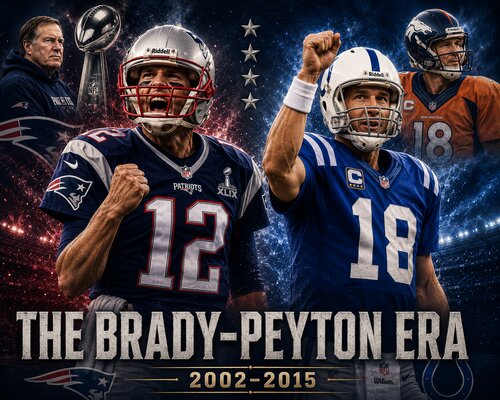
When the New England Patriots narrowly missed the playoffs in 2002, it seemed their ‘01 title run was every bit as fluky as it seemed in the moment. It turned out, it was anything but. Brady, Belichick and the Patriots were quickly back, and they won back-to-back championships in 2003 and 2004.
Brady became much more than the game manager he was in ’01, but these were still teams that were led by a great defense. Belichick orchestrated a unit that included Tedy Bruschi, Ty Law, Rodney Harrison, and more. And that defense made its biggest statements in playoff games against Indianapolis.
Peyton Manning’s star was on the rise, as he won MVP awards in 2003 and 2004 and put the Indianapolis Colts into contention. Both years, they came to Foxboro for the playoffs. Both years, the physical Patriot defense shut them down.
Thus, the framework of a debate that would define the next era of the NFL was in place. Was it Brady or Peyton? One had the rings. The other had the MVP trophies. One was backed up by a great defense. The other wasn’t. One had a demonstrated ability to deliver in the biggest moments. The other was still searching.
PEYTON’S PURSUIT
2005 looked like Indianapolis’ year when they started 13-0. But a slow finish to the season was followed by playoff collapse at home against the Pittsburgh Steelers. Instead of Peyton getting his long-sought ring, it was Steeler head coach Bill Cowher getting a long overdue breakthrough—and young Ben Roethlisberger winning the first of two rings at quarterback.
A year later though, the monkey came off Peyton’s back. He won the Super Bowl, and the biggest moment was a memorable AFC Championship Game against the Patriots, when Indianapolis rallied from a 21-3 deficit. The Colts had done it, and they had done it by going through their biggest foe.
Peyton’s pursuit of a second ring–and the elevation of historical status that comes with being a multi-time champion–looked ready to come in 2009. Manning won another MVP award, and the Colts went back to the Super Bowl, where they were favored to beat the upstart New Orleans Saints.
But another prolific quarterback, Drew Brees, had his moment. Combined with a timely onside kick and a big interception by defensive back Tracy Porter, the Saints became the toast of the Bayou with a 31-17 win.
Prior to the 2011 season, Manning severely injured his neck. He would definitely miss the entire ’11 campaign and there were doubts if he would play again. Indianapolis finished with the worst record in the league and used the first overall pick in the draft to take Stanford quarterback Andrew Luck.
Peyton wasn’t done though. He would take his bid for a comeback and a second ring to Denver.
THE UNFINISHED CORONATION
While Peyton chased a second ring, Brady chased a fourth Super Bowl win that would tie him with Joe Montana and Terry Bradshaw. Brady kept getting better. But he ran into repeated frustration.
The 2006 team that lost to Indianapolis was one that Brady essentially put on his back to get that far. In 2007, he won his first MVP award and led the Patriots to a historic undefeated regular season. They returned to the Super Bowl. Brady was ready to settle the debate once and for all. Until the New York Giants, with an aggressive defensive front, bottled up the explosive Patriot attack, took advantage of a stunning desperation pass late in the game and shocked the world with a 17-14 win.
2008 turned into a lost year, when Brady tore an ACL in Week 1 and missed the rest of the season. He came back in 2009, played well and put the Patriots back in the playoffs. But they weren’t a great team and were quickly eliminated.
In 2010, Brady won another MVP trophy, and New England appeared to be peaking in January. In a shocking turnabout, the Rex Ryan-led New York Jets—a team the Patriots had beaten 45-3 just over a month earlier—came to Foxboro and bounced New England from the playoffs. Instead of a Brady coronation, Super Bowl Sunday belonged to the Green Bay Packers and their rising star, Aaron Rodgers.
The Patriots returned to the Super Bowl in 2011 and got a second crack at the Giants. It ended much the same way. Brady walked off the field late in the game with a lead. New York, led by Peyton’s brother Eli Manning, made a late drive that included an impossible deep pass and catch. And more Patriot heartbreak.
Tom Brady continued to be one of the NFL’s defining players, but he couldn’t get separation from Peyton in the ongoing public debate, and he was losing Super Bowls to Eli.
RIVALRY RENEWED
In 2012, Peyton not only came back from four neck surgeries in Denver, he looked like he hadn’t missed a beat. His Broncos rolled to the 1-seed in the AFC playoffs. Brady’s Patriots cruised into the 2-seed. They looked poised for another AFC Championship Game battle.
Until the Baltimore Ravens got in the way. The Ravens’ AFC North rivalry with the Steelers was as fierce as any. A defense led by Ray Lewis, Ed Reed, and Terrell Suggs were seeking a playoff breakthrough. When quarterback Joe Flacco got hot in January ’12, the Ravens had their moment. They won in Denver, won in New England and won the Super Bowl.
The Brady-Peyton AFC Championship Game rematch had to wait until 2013. Peyton won that one and evened the head-to-head playoff rivalry at two wins apiece. But the Super Bowl was cruel to the Broncos. The Seattle Seahawks were a rising force, with their Legion of Boom defense and a young mobile quarterback in Russell Wilson. Seattle demolished Denver.
Brady and Peyton were still playing at Hall of Fame levels, but it was quarterbacks in the early to middle stages of their careers winning Super Bowls, from Rodgers to Wilson to Flacco. Rodgers, with an MVP award under his belt to go along with a ring, was regarded by many as better right now than either of the great veterans in Denver and New England.
A growing theory explained this by saying youth was better served in the cold weather of January rather than veterans, however great, playing on older legs at the end of a long season.
TRADING BLOWS
But the proud veterans had their day coming. In 2014, Brady returned to the Super Bowl. While controversy swirled over deflated footballs and the Legion of Boom was after a repeat title, Brady took his place in history. Trailing 24-14 in the fourth quarter, against the best defense of his era, the Patriot quarterback calmly led two touchdown drives. The victory was secured with a memorable interception in the end zone. Brady joined Montana and Bradshaw with four rings.
Peyton’s body was clearly on its last legs, and the Broncos were led by an outstanding defense. The great quarterback was now a game-manager. And in that regard, Peyton ended his career the way Brady began his—playing smart and letting the D do the work. Manning’s Broncos went on a playoff run that started with beating Big Ben’s Steelers and then winning a thriller over the Patriots. The run ended with an upset victory over the Carolina Panthers in the Super Bowl. Peyton had his second ring and rode off into the sunset.
The head-to-head rivalry was over. Brady’s four rings still gave him the leg up in the public debate. But Peyton’s defenders now had their own ammunition–two rings, a 3-2 record against Brady in the playoffs and what was now a 5-2 edge in MVP trophies.
And the debate didn’t stop there. Was Rodgers, now a two-time MVP winner, the best contemporary quarterback in the NFL? And when it came to the Patriots, was Belichick really the genius behind it all?
Sports media feasted on all of it. But more information was coming.