
Players leaving after their freshman seasons weren’t new—most famously, Carmelo Anthony led Syracuse to the 2003 national title before departing for the pros. But even after NBA eligibility rules effectively created the modern one-and-done era in 2006, the practice was still seen as something to be used on a limited basis—to augment an established roster, akin to trade deadline acquisition in Major League Baseball. No major program had yet built its entire identity around the expectation that its best players would leave after one season.
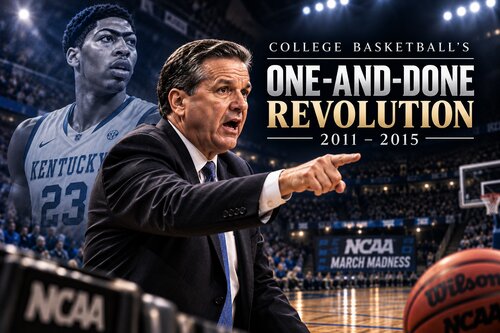
ohn Calipari came to Kentucky in 2010 and decided to do build his program around changing realities. Calipari, leveraging his past experience in the NBA, positioned himself as the coach who could best help the nation’s top freshmen make the most of their one year in college basketball. And the elite talent came rolling into Lexington.
The Wildcats returned to the Final Four in 2011, the first appearance since their late 1990s apex. While UConn won another national title that year, Kentucky had found a formula. In 2012, Calipari started three freshmen, led by Anthony Davis, alongside sophomores who had themselves arrived as elite recruits. The Wildcats won a national championship with a historically young team.
Davis and other top players quickly left, but there was always someone rolling in behind them. Kentucky had a brief hiccup in 2013, enabling Louisville, coached by Rick Pitino, to win a national championship. But by 2014, the Wildcats were back.
Throughout the ’14 NCAA Tournament, Kentucky showed that, even in close games, talent mattered more than experience down the stretch. A mostly freshman starting lineup won nail-biters over top-ranked Wichita State, Louisville and Michigan to get to the Final Four. Their rookie two-guard Aaron Harrison made big shot after big shot. The biggest one came when he drilled a late trey to beat Wisconsin by a point in the national semifinal.
Kentucky didn’t finish the job that year—UConn, now coached by Kevin Ollie, reinforced an uncanny ability to close out championships when they reached the Final Four. The Wildcats again said goodbye to most of their best players. And again said hello to a crop of future pros.
Calipari’s One-and-Dones thundered through 2015, with Karl-Anthony Towns leading the way. They were undefeated and came to the Final Four ready to complete college basketball’s first perfect season since 1976.
Wisconsin had been thirsting for a chance at revenge. The Badgers made it back to the biggest stage in ’15, setting up the first national semifinal rematch in over 45 years. But this was more than a rare rematch of a great basketball game. It was a study in contrasts. Wisconsin, coached by Bo Ryan, was a classic “recruit and develop” program that represented the polar opposite of Calipari’s one-and-done model.
In a tight game, Sam Dekker bagged a money trey down the stretch, Wisconsin got their revenge and Kentucky’s bid for perfection fell short.
But even though the Wildcats didn’t win it all, their imprint was still all over Monday night’s title game. Duke’s Mike Krzyzewski got his fifth ring in beating Wisconsin. A man previously resistant to recruiting freshman that everyone knew were immediately leaving, the Duke boss had read the signs of the times and his starting lineup had three “one and dones.” For better or for worse, college basketball had dramatically changed.