
Learn more:
READ MORE ABOUT THE 1981 NFL SEASON
READ MORE ABOUT THE 1982 NFL SEASON
READ MORE ABOUT THE 1983 NFL SEASON
READ MORE ABOUT THE 1984 NFL SEASON
READ MORE ABOUT THE 1985 NFL SEASON
READ MORE ABOUT THE 1986 NFL SEASON
READ MORE ABOUT THE 1987 NFL SEASON
READ MORE ABOUT THE 1988 NFL SEASON
READ MORE ABOUT THE 1989 NFL SEASON
READ MORE ABOUT THE 1990 NFL SEASON
READ MORE ABOUT THE 1991 NFL SEASON
1981 was a seminal year in the history of the NFL. The San Francisco 49ers came out of nowhere and won the Super Bowl. It’s not just that the 49ers went from 6-10 in 1980 to winning it all. It’s that they ushered in a new era for the league and their entire way of winning had a transformative effect that lives on today.
Furthermore, the 49ers were only one part of a prolonged era where the NFC consistently produced the league’s best team—in fact, usually the best 2-3 teams in any given season. The NFC won every Super Bowl but one in this era and usually by blowout margins. Four franchises formed the pillars of that dominance—in addition to San Francisco, there was the Washington Redskins, New York Giants and Chicago Bears, each with their own way of winning.
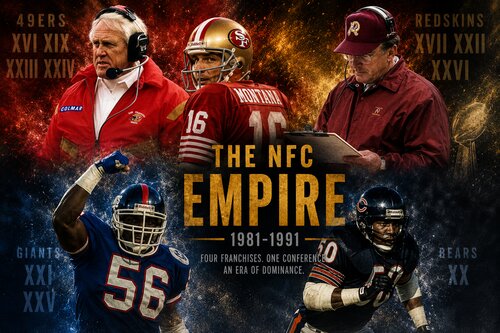
THE WEST COAST REVOLUTION
Bill Walsh was the head coach, and he introduced the “West Coast offense” with its short precision passing to a league that had primarily been about running the ball and throwing deep. Walsh found the perfect quarterback to execute this system in the great Joe Montana. In the 1981 NFC Championship Game, Montana upset the Dallas Cowboys, one of the great NFC powers of the 1970s. Montana’s game-winning drive, capped off by Dwight Clark’s catch in the end zone, was more than an exciting moment. It signaled the changing of the guard.
San Francisco went on to defeat Cincinnati in that year’s Super Bowl—ironically, the Bengals were where Walsh had once been an assistant and quarterback Ken Anderson was a prime example of the short precision passer that was about to come into vogue.
And the winning continued. The 49ers became a perennial playoff team throughout the decade. In 1984, they ripped off a 15-1 season and capped it off by destroying Dan Marino’s Miami Dolphins in the Super Bowl. The ’84 49ers are included on any credible list of the greatest single-season teams of all time.
The 49ers won another Super Bowl in 1988, again beating Cincinnati with Montana delivering the winning touchdown pass in the final minute. After the season, Walsh retired and handed the reins to defensive coordinator George Seifert. The machine rolled on. San Francisco repeated in 1989 in even more dominant fashion, capping off their 14-2 regular season by winning their three postseason games by a combined score of 126-26.
A bid for a three-peat ended with a crushing NFC Championship Game loss. Injuries began to wear Montana down. While neither his story, nor that of the 49ers, was over, this chapter of each one’s history was complete.
Even more than the four Lombardi Trophies, what ultimately defined this era of San Francisco 49ers football was its long-term impact. The West Coast offense became the norm throughout the league. Walsh’s assistants were hired as head coaches with such frequency that his “Coaching Tree” reads like the family dynasty of a great monarch.
In the long-term no one defined his NFL generation like William Ernest Walsh, and in this short-term era no one won more championships than his 49ers.
THE ADAPTIVE DYNASTY
The Washington Redskins weren’t far behind San Francisco, as head coach Joe Gibbs etched his own name into the history books. If the 49ers achieved their success with a system that changed the game, the Redskins did it through Gibbs’ ability to constantly change systems to adapt to frequently changing personnel—the signature of which was his unprecedented feat of winning three Super Bowls with different starting quarterbacks.
1982 was the breakthrough year. Gibbs, who had first made his reputation as the offensive coordinator for the high-powered passing offense of the San Diego Chargers, made his head coaching breakthrough doing completely the opposite—winning behind the power running of John Riggins and a big offensive line. In a strike-shortened year, the Redskins won their first Super Bowl.
The strange circumstances of 1982 left people skeptical of whether Washington was a long-term power. 1983 answered those questions. Quarterback Joe Theismann had the best year of his career, winning the MVP. Combined with Riggins’ running, the Redskins blew out the scoreboard all year long.
That ’83 team fell one step short of repeating. The Los Angeles Raiders, led by Marcus Allen and an elite pair of corners in Mike Haynes and Lester Hayes, had the formula to stop Washington and the Raiders won the Super Bowl in a surprising blowout.
Gibbs brought the Redskins back to the top in 1987—ironically, another year where a strike was involved, albeit not as lasting as 1982. This time, the head coach did it with two quarterbacks. Jay Schroeder started most of the season and got the ‘Skins into the playoffs. Doug Williams didn’t take over until the season finale. Williams became the first black quarterback to win a Super Bowl.
After stepping back for a couple of years to retool, Gibbs returned to the playoffs in 1990—again with a new quarterback, this time Mark Rypien, and a mostly new cast. And in 1991, Washington tore off one of the most dominant seasons of all-time, right up with there with the ’84 49ers and other great teams who are in the discussion for greatest ever. The Redskins cruised through the regular season and were never tested in the playoffs.
Gibbs retired temporarily after 1992 and the Redskins stepped back. But his adaptability in winning three Super Bowl titles by using four different starting quarterbacks remains unmatched.
THE DEFENSE NEVER RESTS
For San Francisco, it was about the system. For Washington, it was about adjustments. For the Chicago Bears and New York Giants, the victory formula was much simpler—a defense that could destroy you.
Mike Ditka became an iconic figure as the head coach in Chicago, and he had a colorful defensive coordinator in Buddy Ryan and an all-time great middle linebacker in Mike Singletary. The “46 Defense” designed by the innovative Ryan made the Bears a perennial contender, and the high point was their dominant 1985 season. Chicago went 15-1 and didn’t allow a playoff touchdown until very late in their Super Bowl blowout of the New England Patriots.
The Giants, mediocre through the 1970s, entered a new era when they drafted outside linebacker Lawrence Taylor. “L.T.” became another seminal figure in the historical arc of the league. He was the first linebacker to really make his reputation as a pass rusher, the forerunner of today’s “edge” players.
Taylor’s force and uniqueness were weaponized by a young defensive coordinator named Bill Belichick. And that aggressive defense was complemented by the power running attack imposed by head coach Bill Parcells.
If Bill Walsh changed offensive football, Taylor changed the defensive side of the ball. And L.T.’s Giants won Super Bowls in both 1986 and 1990.
THE AFC’S DEEP BENCH
This was an era that was about the NFC. The Raiders’ title in 1983 was the only time the AFC won the Super Bowl, and that stretch continued into the late 1990s. But that didn’t mean there weren’t great stories in the AFC.
While the NFC had greatness at the top, the AFC had a deeper middle class. The Raiders contended through the mid-1980s. Marino exploded onto the scene in Miami, winning the MVP award in 1984. Warren Moon put the old Houston Oilers back on the map. And John Elway arrived in Denver. The late 1980s saw Elway’s Broncos square off with Marty Schottenheimer’s Cleveland Browns in a pair of epic AFC Championship Games.
The 1981-91 era is as historically significant as any in the history of the league. From offensive and defensive schematics to coaching adaptability, this 11-year period changed the way the game is played and coached. All of it unfolded in the context of sustained dominance—at least at the top—by the NFC.