
Even prior to 1980, the NHL was defined by a dynasty—the Montreal Canadiens had just won their fourth straight Stanley Cup and were the league’s flagship franchise. In retrospect, perhaps it’s ironic that Montreal was most resistant to the expansion that ushered in the league’s modern era in 1980, because they ended up as the franchise with the most to lose. The league would continue to be defined by dynasties, but it would no longer be Montreal.
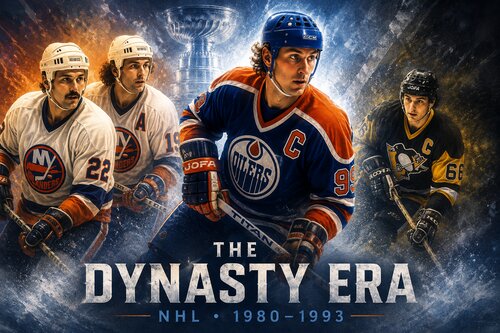
The New York Islanders displaced Montreal and won the decade’s first four Cups. While the Islanders were dominating, a star was coming out of northwest Canada. Wayne Gretzky was putting Edmonton on the map. He won the Hart Trophy as the league MVP his rookie year and began an astonishing run of eight straight MVP campaigns.
In 1984, Gretzky, now surrounded by a complete team, broke through and won the Cup. The Oilers produced a dynasty of their own, one so deep that it even survived Gretzky’s high-profile departure later in the decade.
It was a compact league—only 21 franchises and 16 qualified for the playoffs. It really was all about the postseason in the NHL of this era and these two franchises mastered it better than anyone.
The Islanders Dynasty (1980–1983)
Bryan Trottier and Mike Bossy fueled the New York attack. Denis Potvin was an elite defenseman. Billy Smith anchored everything in the net. Head coach Al Arbour orchestrated it all from the bench. All five men are in the Hall of Fame.
The Islanders’ dominance was such that only twice in four years did they even have to a play a deciding game in a playoff series. One of them, in 1982, was a doozy, and it came perilously close to prematurely ending the dynasty.
In what was then a best-of-five first round, New York had let the upstart Pittsburgh Penguins off the mat, getting forced to a Game 5 after winning the first two. Then the Isles trailed 3-1 with just over five minutes to play. After cutting the lead to 3-2, John Tonelli carved himself a place in Long Island history—he scored with two minutes to go tie it, and again in overtime to win.
New York survived the biggest threat to their dominance, and went on to sweep the next two rounds and claim their third straight Cup in 1982. They did it again in 1983, sweeping out Gretzky’s Oilers in the Finals. The rising star was coming, but he hadn’t arrived yet.
The Oilers Dynasty (1984–1990)
The NHL got a rare changing-of-the-guard moment in 1984. The Oilers earned a rematch with the Islanders, and Edmonton formally displaced the old dynasty with a comfortable five-game series win.
Gretzky operated at a level the league has never seen before or since. A passer so skilled that he would still be the NHL’s all-time points leader today without scoring a single goal, Gretzky was surrounded by an extraordinary collection of talent. Mark Messier, Paul Coffey, Jarri Kurri, and goaltender Grant Fuhr were all Hall of Famers in their own right—and, as time would demonstrate, capable of leading a Stanley Cup winner on their own.
This dynasty didn’t move in a straight line. After winning a repeat Cup in 1985, there was a resurgence from Montreal, who won in 1986 behind a rookie goalie named Patrick Roy. Edmonton promptly returned to the top in 1987 and 1988, making it four Cups in five years.
In the summer of 1988, the trade of Gretzky to the Los Angeles Kings was one of the biggest stories in the sports world, a level of publicity rare for a league that—at least in the United States—often has to fight for headlines. It created a window for the Calgary Flames to capture the Cup in 1989.
But the Oilers persisted and bounced back. In 1990, the franchise completed their dynasty arc by winning a fifth championship in seven seasons—proof, that as historic as Gretzky was, the team was much more than a single star.
The Penguin Transition (1991-92)
No one has dominated the NHL like the Islanders and Oilers did throughout the 1980s, but their decline didn’t mean a sudden insurgence of parity. There were still flashes of sustained excellence and one of them came out of Pittsburgh.
Mario Lemieux, who would go on to impact the Penguins and the sports culture of Pittsburgh as much as any one person could over a career on the ice and in the front office, was the focal point. Alongside him was Jaromir Jagr, giving the Pens an attack that could overwhelm opponents.
Pittsburgh won back-to-back Stanley Cups in in 1991 and 1992. In a different era, perhaps the Pens might have followed in the path of their recent predecessors and continued to rack up titles. But with expansion and financial pressures the league was changing.
The Last Echo (1993)
Before the NHL formally entered a new era, one more driven by parity and unpredictability, the 1993 season offered one final throwback. Montreal captured their 24th Stanley Cup. The opponent in the Finals was Los Angeles, carried by Getzky. The 1993 season offered one final echo—and then the dynasty age was gone, to be replaced by an era of expansion, a more fluid playoff structure and competitive balance.