
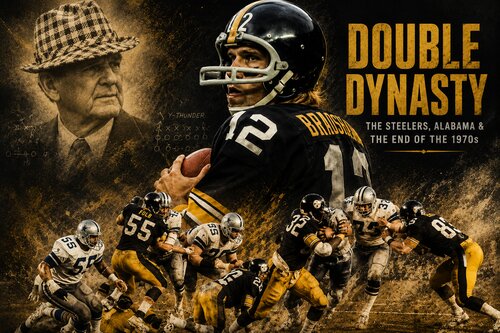
A concentrated balance of power that defined the top of both the NFL and college football throughout the 1970s finally tipped at the end of the decade. The Pittsburgh Steelers and Alabama Crimson Tide separated themselves from the field. It remains the only two-year stretch in history when both the Super Bowl champion and the national champion repeated in unison.
The Steelers separated themselves from the NFL pack. Alabama’s near-miss frustration transformed into sustained control. But each team had credible challengers who nearly gave the decade a different ending.
Pittsburgh and Dallas met at the Super Bowl that followed the ’78 season, each with the opportunity to be the first to three rings. The Steelers won that game. The two franchises seemed on track for a rematch in ’79. Until the Rams upset the Cowboys and got their overdue Super Bowl trip. But Los Angeles couldn’t hold off Pittsburgh, and the Steelers grabbed Ring #4. The shared dominance of the 1970s had become a clear hierarchy.
Alabama and USC both soared near the top of the polls in both 1978 and 1979. The ’78 championship turned on the Tide’s Sugar Bowl goal-line stand against Penn State—a sequence that denied the Lions what would have been a sure national title and led to a split crown between ‘Bama and USC In ’79, there was no ambiguity. Undefeated Alabama was #1 and once-tied USC was #2. A Tide program that had spent the decade knocking on the door now controlled it.
Two dynasties had taken shape. Places in history were secure. But the margins were narrow and the game was evolving. For the moment though, the Steelers and Alabama stood alone.
THE HINGE YEAR OF 1980
An NFL Interlude
The 1980 season stands apart, belonging neither fully to the era left behind or the era to come. An old standby, the Raiders won the Super Bowl. But it was Tom Flores and Jim Plunkett instead of John Madden and Ken Stabler. The Cowboys were in the NFC Championship Game, but it was Danny White in place of Roger Staubach.
New contenders were arising. The San Diego Chargers featured a high-powered passing attack that pointed toward the future. The Philadelphia Eagles reached their first Super Bowl. The Buffalo Bills did it the old-fashioned way on the ground and became a contender. Meanwhile, familiar powers like the Rams and Vikings remained in the postseason but no longer imposed themselves on the league.
And most symbolic, the Steelers fell and missed the playoffs. The 1980s were taking shape. But they weren’t here yet.
A College Football Interlude: The Circle Widens
1980 looks forward while quietly closing old doors. Alabama remained a New Year’s Day presence, but SEC rival Georgia, behind freshman Herschel Walker, that claimed the national title. The Bulldogs do it by defeating Notre Dame in the Sugar Bowl, as Dan Devine retires in South Bend.
Familiar programs contend, but it looks different. Pitt replaces Tony Dorsett’s legs with Dan Marino’s arm and the defensive dominance of Hugh Green. Michigan goes to a Rose Bowl—and this time they win it. Oklahoma remained a fixture in the Orange Bowl, defeating Florida State for the second straight year. Yet Florida State’s continued presence signaled that Bobby Bowden’s program was becoming a permanent member of the national conversation.
The old order was still standing. But the circle of programs capable of reaching the top was beginning to widen.