
You can read the season-long overviews of the NFL from 1970 to 1977 at the links below. Individual team articles are linked within them. You can read not just about the seven franchises highlighted here, but those that challenged them.
1970 NFL Season Overview
1971 NFL Season Overview
1972 NFL Season Overview
1973 NFL Season Overview
1974 NFL Season Overview
1975 NFL Season Overview
1976 NFL Season Overview
1977 NFL Season Overview
The first eight years after the NFL and AFL merged were a period of concentrated dominance, without a single dominant superpower. Seven franchises—the Dallas Cowboys, Miami Dolphins, Pittsburgh Steelers, Oakland Raiders, Minnesota Vikings, Washington Redskins and Los Angeles Rams–defined the league.
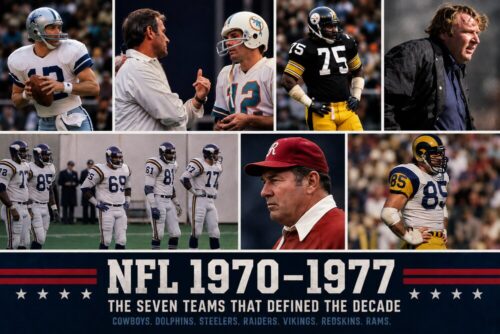
Over the eight seasons from 1970-77, these seven teams accounted for the following:
- 7 of 8 Super Bowl championships
- 14 of 16 Super Bowl appearances
- 27 of 32 AFC/NFC Championship Game appearances
- 50 of 64 available playoff berths (only eight teams per year qualified).
A holdover power from the prior four years, Dallas had been perpetual bridesmaids to Vince Lombardi’s Green Bay Packers. Coached by Tom Landry, the Cowboys started to break through as Green Bay declined. They reached the Super Bowl in 1970. A quarterback controversy was settled a year later when Landry opted for Roger Staubach over Craig Morton. The decision triggered a run to a breakthrough championship in 1971. With Staubach, the “Doomsday Defense,” and running backs that started with Duane Thomas and transitioned to Tony Dorsett, Dallas won two Super Bowls and reached four in this eight-year stretch.
Miami was a young franchise, and they hired Don Shula away from the Baltimore Colts. Shula built the Dolphins around an exceptionally disciplined defense and a power running game led by the three-headed monster of Larry Csonka, Mercury Morris, and Jim Kiick. Shula found his quarterback in Bob Griese and reached the Super Bowl in 1971. A year later, even Griese’s injury and the elevation of veteran backup Earl Morrall for much of the season didn’t stop Miami from posting a historic unbeaten season and a repeat title in 1973.
They were a long-suffering franchise that bore no resemblance to the stable contender modern fans are familiar with. Chuck Noll arrived and changed all of that. It took a few years to stabilize the quarterback position, with Terry Bradshaw eventually emerging. But whoever took snaps had the benefit of giving the football to Franco Harris. Even more important, they had the benefit of support from one of the great defenses of all-time. The “Steel Curtain” led the way as Pittsburgh began making the playoffs in 1972 and in 1974-75, won repeat Super Bowl championships.
Oakland became a regular power in the pre-merger era, reaching the Super Bowl in 1967. John Madden took over the coaching reins two years later. The Raiders become one of the league’s colorful franchises, with maverick owner Al Davis epitomizing a counter-culture mindset that animated the team. In the early part of the decade, Madden elevated Ken Stabler to the quarterback job. Explosive offensive talent surrounded Stabler, the Raiders were a playoff regular and their rivalry with the Steelers became the stuff of legend. In 1976, Oakland finally broke through and won the Super Bowl.
The Vikes were near the top almost every year. After trading Fran Tarkenton away in 1967, head coach Bud Grant reversed course five years later and traded to get the scrambling Hall of Fame quarterback back. Tarkenton gave juice to a lineup that was anchored by the legendary “Purple Gang” defense. The Vikings, who had already reached a Super Bowl in 1969, made it back to the biggest stage in 1973, 1974 and 1976. They never did get that last win of the season, but no one was more consistent in getting there.
Washington had a long and mostly inept history when George Allen became the head coach in 1971. Allen, whose tolerance for rookies and young players was non-existent, began trading for veterans. The newly cast “Over the Hill Gang” immediately made the playoffs. Allen had to juggle veterans at quarterback, primarily using Billy Kilmer, but also relying on the aging, but legendary Sonny Jurgensen. Allen turned running back Larry Brown into the league’s MVP in 1972, a year the Redskins made the Super Bowl and their twice-annual battles with the Cowboys produced memorable moments.
L.A. started winning the NFC West on an annual basis in 1973 and reached three consecutive NFC Championship Games. James Harris became the first African-American player to open the season as a starting quarterback and the first to start a playoff game. The Rams still had a quarterback controversy, with Harris, veteran John Hadl and young Pat Haden all playing roles. Above all though, they had head coach Chuck Knox implementing a tough running game built around Lawrence McCutcheon and a deep defensive front four led by the great Jack Youngblood.
DEFENSE, RIVALRIES & THE PRE-MODERN NFL
It was a different era in pro football. All seven of these teams overcame different issues at the quarterback position, something that underscores how much defense and the running game predominated. It led to the league making rules changes that would open up passing games in 1978.
But what ultimately defines this era is not dominance, but familiarity. Playoff rivalries formed and hardened. While the balance of power was concentrated at the top, contenders took turns hoisting the trophy.
No single franchise among these seven separated themselves from the pack.
At least not yet.