
The events of 2003 left Major League Baseball with a lot of unfinished business. The Red Sox, along with the Chicago Cubs, owners of two of the most storied championship droughts in all of sports, had each come within five outs of the World Series before giving up leads. A new era, one that would be marked by redemption, began in 2004 and it was Boston leading the way.
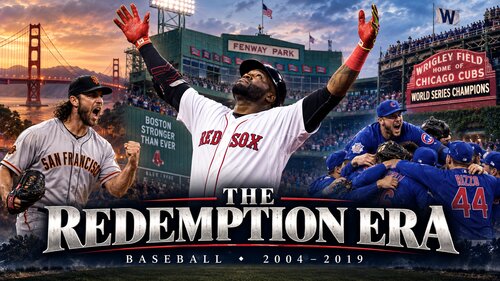
NEW ENGLAND CATHARSIS
The Red Sox did not merely win the World Series in 2004 to end an 86-year championship drought. They did it in dramatic fashion. Their ALCS rematch with the Yankees was going exceptionally poorly, as Boston lost the first three games. Then they suddenly turned it around, and won four straight, an unprecedented comeback in a best-of-seven baseball series. Then they swept the St. Louis Cardinals. Generations of New England fans had their redemption.
The Red Sox then went to work on making up for lost time. In 2007, they won it again. In 2013, playing for a city that had been rocked by the Boston Marathon bombing in April, the Red Sox reached the World Series and again beat the Cardinals. And in 2018, they captured a fourth championship, securing their legacy as the most decorated franchise of the early part of the 21st century.
SAN FRANCISCO’S QUIET DYNASTY
The Giants had relocated to San Francisco in 1958 and had yet to win a World Series on the West Coast. In 2010, they broke through. Like the Red Sox, the Giants decided that once wasn’t nearly enough. They won again in 2012, with an improbable comeback from a 3-1 NLCS series deficit against St. Louis.
Those two championships were impressive, but for pure history, 2014 became the defining moment, when starting pitcher Madison Bumgarner had an October for the ages. Bumgarner won a winner-take-all shutout in the wild-card game, was dominant in the NLCS and saved his best for last in the World Series where he won two games and then dominated in long relief in Game 7.
MISSOURI RESURGENCE
St. Louis had been stuck playing the role of obstacle in the redemption stories of Boston and San Francisco. But the proud Cardinal franchise had some unfinished business of their own, looking for their first World Series title since 1982.
2006 wasn’t the best St. Louis team, but they won when it mattered, including a thrilling seven-game NLCS over the New York Mets.
Five years later, St. Louis did it with even more drama. Left for dead by late summer, the Cardinals stormed down the stretch to get into the playoffs. They stunned the heavily favored Philadelphia Phillies in the playoffs. In the World Series against the Texas Rangers, St. Louis was down to their final out in Game 6 on two different occasions. Both times, they rallied, forced Game 7, and won another championship.
The Cardinals had at least been consistent contenders during their championship drought. The same could not be said of their fellow Missourians. The Kansas City Royals had been completely off the radar since winning in 1985. Their 2014 loss to San Francisco marked K.C.’s return to prominence and 2015 was the fulfillment. The Royals won 95 games and then consistently executed in the late innings throughout October, to complete their return to the top.
There was one big notable redemption story still missing—the one on the North Side of Chicago.
CHICAGO’S LONG WAIT ENDS
By 2016, it had been over a century since Cubs fans had seen a World Series champion. It had been 1945 since they even reached the Fall Classic. A talented team came into ’16 with great expectations and lived up to them. Chicago easily posted the best record in baseball.
October presented its challenges, but the Cubs finally won the National League pennant. That set up a World Series with another star-crossed franchise, the Cleveland Indians. Someone was going to break through. For four games, it looked like Chicago would have to keep waiting, as their heavily favored team dug a 3-1 deficit.
But the Cubs won the next two games. Game 7 went to extra innings, had a short rain delay that added to the dramatic effect, and Chicago finally won. The longest wait in baseball was finally over.
The Cub title also completed a redemption arc for the Windy City as a whole. On the South Side, the White Sox had not won a title since 1917. In 2005, led by dominant starting pitching, the White Sox dethroned the Red Sox and then swept their way through the Fall Classic.
A WAVE OF BREAKTHROUGHS
Across the league, other long-silent teams got their moment. The Philadelphia Phillies, a historic franchise whose only crown had been in 1980, finally won again in 2008. The Houston Astros, owners of notable postseason heartbreaks, did it in 2017. While debate over sign-stealing would soon surround this championship, Houston had broken through.
The Washington Nationals didn’t have a history of heartbreak—or even a history at all, having just relocated from Montreal in 2005. But they had suffered some tough playoff losses and were heirs to an Expos tradition that had seen more than its share of frustration. The Nationals won it in 2019, giving the nation’s capital a long-awaited breakthrough.
REDEMPTION…BUT NOT REALLY: THE 2020 ECHO
While some franchises were redeeming themselves, one of MLB’s most successful teams was building up a need for redemption. The Los Angeles Dodgers hadn’t been to the throne room since 1988. And they began to pile up postseason losses, including the World Series in 2017 and 2018, and as a heavy favorite in 2019. Whether the Dodgers would ever get back on top was a pertinent question for baseball fans.
In 2020, they did it, but it was a championship that came with question marks. It was the COVID year, with a shortened 60-game schedule, and a 16-team bracket played on neutral fields without fans. It was the most truncated setup MLB had seen since the strike year of 1981—ironically also won by a Dodger team needing a breakthrough.
The questions weren’t necessarily fair—Los Angeles was actually deprived of the advantages they might have otherwise enjoyed, from getting a long regular season for their talent to assert itself, to having to play on neutral fields as a 1-seed. But fair or not, the questions lingered, as baseball pivoted to a new era.