
Today’s college sports landscape is cluttered by mega-conferences, but it wasn’t always that way. Schools playing as independents was once highly common, particularly among the basketball programs for Catholic universities. From the Northeast corridor to the Midwest, some of NCAA basketball’s legendary names and great rivalries came out of this era.
One of those rivalries was the three-way joust for supremacy in the Midwest between Marquette, Notre Dame, and DePaul over the late 1960s, the entire 1970s and into the 1980s.
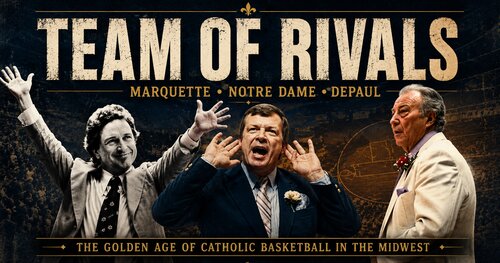
All three were nationally elite for roughly a decade at different points in this stretch. The head coaches, from Al McGuire to Digger Phelps to Ray Meyer were virtually national brands. In the late 1970s, each school had their best basketball season—the Warriors’ national title in 1977, followed by the Irish and Blue Demons making the Final Four in 1978 and 1979, respectively.
OUAT Sports has compiled a series of articles that will take you season-by-season through each school’s high point. You’ll read about their key players in each season, their notable regular season arc, and their NCAA Tournament games.
Even more than that, you can watch the entire sport of college basketball evolve before your eyes. When this era effectively started with McGuire’s arrival at Marquette in the late 1960s, college basketball was a niche sport, completely dominated by UCLA, with just 41 teams making the NCAA and NIT tournaments combined. There was no shot clock or three-point line, and televised games were the exception rather than the rule.
By the time the era ended in 1987, we had a 64-team NCAA Tournament bracket that was properly seeded and balanced, a 45-second shot clock, a three-point line, ESPN doubleheaders every weeknight and “March Madness” now a national event.
The evolution of Marquette-Notre Dame-DePaul, from their rise as national powers to the eventual end of the independent era, is very much a part of that story.
Here’s a look at how each school’s arc unfolded over those two decades, with links to their season articles in their best eras:
MARQUETTE
To a generation of college basketball fans, Al McGuire was as synonymous with the sport as Dick Vitale would become to a later era, thanks to Al’s long tenure calling games with Dick Enberg on NBC. The foundation for that was set by Al’s excellent tenure at Marquette in the 1970s.
He came to the Warriors in 1965 and took over a program that was coming off a five-win season. By 1966, MU was playing winning basketball and by 1968 they were in the NCAA Tournament.
That set the stage for a decade where the Warriors were on the national stage. For six years, through 1973, they dominated regular seasons before losing in the regionals of the NCAAs. For six years, through 1973, they dominated regular seasons before losing in the regionals of the NCAAs. But that tidy overview understates how much color filled this period. From Jim Chones’ dramatic departure to the ABA in late 1972, to Al telling the NCAA to take its tournament bid and shove it in 1970, there was plenty of action in Milwaukee over these six season.
In 1974, Al broke through and made the Final Four. In 1977, with his retirement already announced, he authored arguably the most famous swan song in sports history—a surprise run to the national championship, capped by the enduring image of the hard-edged coach in tears on the sideline in the final moments of the title game.
You can read more about the colorful ten years of 1968-77 at the links below:
1968: Al’s 1st NCAA Tournament
1969: One Shot From The Final Four
1970: Al Turns Down The NCAA
1971: A Perfect Regular Season
1972: A Dramatic Departure
1973: Still Knocking On The Final Four Door
1974: Breakthrough
1975: New Foundations
1976: Near Perfection
1977: Al Goes Out A Winner
NOTRE DAME
Digger Phelps wasn’t far behind McGuire when it came to color, flair, and national renown. In fact, before Al began his television career, Digger might have been the bigger national figure. In an era when college basketball wasn’t available somewhere on television every night, Notre Dame got as much national exposure as anyone. And Digger, with his stage presence, knew how to play to it.
In 1972, Phelps inherited a program that had enjoyed a steady run of recent success, but one where nearly every key player had departed. After a brutal six-win season began his South Bend tenure, the trajectory immediately moved back upward. By 1974, Notre Dame was a national contender.
During that ’74 season, the Irish delivered one of college basketball’s most famous regular season results. They upset UCLA and the Bruins’ 88-game winning streak under John Wooden. That win foreshadowed the eventual end of the Bruin Dynasty later that March and an era of greater parity after Wooden’s retirement following the 1975 season. For our purposes here, it also ushered in an era where Notre Dame developed a giant-killer reputation.
The ensuing eight years through 1981 were marked by consistent national contention and more than a few victories over #1-ranked teams. While Digger repeatedly ran into trouble in March, he also made what remains the school’s only Final Four appearance.
You can read more about the golden age of Irish basketball at the links below:
1974: Making History & Starting A New Era
1975: Solidifying A Contender
1976: Another Sweet 16 Heartbreak
1977: A Roller Coaster Ride To The Regionals
1978: Breakthrough
1979: A Step Short Of Magic
1980: Cracks In The Armor
1981: Last Stand Of A Golden Era
DEPAUL
Ray Meyer had a very different career trajectory than Al or Digger, both of whom grew up in New York and came to the Midwest as transplants. Ray, on the other hand, was a Chicago man through and through. He was born in the Windy City. After a brief tenure as an assistant at Notre Dame, he got the DePaul job in 1942. And he stayed there.
In the early part of the 1970s, as Marquette and Notre Dame moved onto the national scene, the Blue Demons briefly lagged behind. Meyer produced teams that were competitive and respectable, but generally fell short of the NCAA Tournament
That started to change in 1976, when DePaul won 20 games and reached the Sweet 16. After a frustrating stepback in 1977, the Blue Demons came roaring back in 1978 and went all the way to the Elite Eight.
That 1978 NCAA run ushered in the greatest era in DePaul basketball history. They made the program’s only Final Four in 1979. From 1980 through 1984, they were one of the sport’s marquee brands. Four times over this five-year stretch, they got #1 seeds in the NCAA Tournament. Their repeated March shortcomings, while a major source of frustration, ironically added to the national interest surrounding the program.
Ray retired following the 1984 season and handed the reins to his son Joey, who continued to produce competitive teams for nearly a decade before the changing dynamics of the sport ultimately caught up with DePaul.
You can read more about the nine years of DePaul’s ascendance at the links below:
1976: NCAA Tournament Breakthrough
1977: Detour
1978: Joining The National Elite
1979: Breakthrough
1980: Triumph & Warning
1981: A Great Season Unfinished
1982: Déjà vu Heartbreak
1983: Retooling
1984: Ray’s Final Run
LAST ECHO
Before the era ended, 1987 offered a last echo. DePaul and Notre Dame each had electric point guards—Rod Strickland for the Blue Demons and David Rivers for the Irish. They each had big regular seasons, and each reached the Sweet 16.
1987 was a seminal year for the sport as a whole—the year the three-point shot was adopted nationally, effectively ushering in a new era. It was the final step in the formation of a college basketball world vastly different from the one McGuire had stepped into more than 20 years earlier when our story began.
The age of the independents was clearly ending. The Catholic independents of the East had already spent most of the decade under the Big East banner, building one of the nation’s premier conferences. It was apparent that the Midwest Catholic schools couldn’t sustain independence much longer. But in 1987, the old world provided one last hurrah.
You can read about each team’s season here:
Notre Dame: David Rivers & The Sweet 16
DePaul: Strickland, Comegys & A Regional Run
The Marquette-Notre Dame-DePaul three-way rivalry of the 1970s and early 1980s remains an indelible part of college basketball lore, well remembered by those who grew up with it. Three Catholic schools. Three legendary coaches. And two decades in which college basketball evolved into the sport we recognize today. Follow the links and watch that history unfold, one season at a time.