
Between 1976 and 1987, college basketball underwent a series of changes and developments and turned what had been a modest and predictable postseason into a centerpiece of Americana.
It was the era when the NCAA Tournament became March Madness.
Six rounds of basketball. Seed lines. A shot clock. A three-point line. Upsets treated not as anomalies, but as expectations.
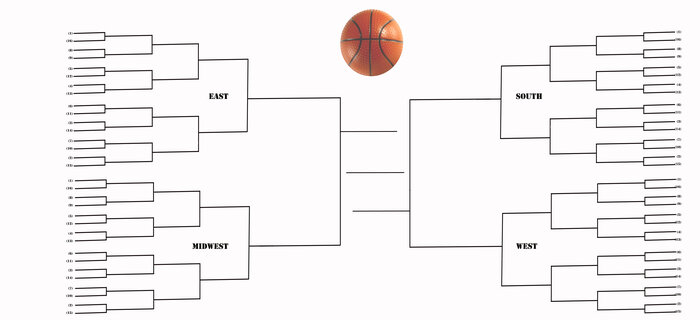
Here’s how it happened:
*Following the 1975 season, UCLA head coach John Wooden retired. The legend who had won ten national championships in twelve years, including an epic 88-game winning streak, stepped down with one final crown. The end of the UCLA Dynasty opened up the path to parity.
*The NCAA began allowing more than one team per conference to make what was then a 32-team field (which was, in itself, a recent expansion from 25). No longer would a great team from a power conference be subject to elimination in a conference tournament. And the change saw immediate fruit—in 1976, two Big Ten teams, Indiana and Michigan, played for the national championship.
*In 1979, the bracket was formally seeded for the first time as the NCAA strove to create a more balanced bracket. The days of unbeaten Indiana in 1976 having to navigate a regional with three other Top 10 teams, were effectively over.
*In 1980, three of the Final Four teams were seeded outside the national top 16 (i.e., #5 or lower). It was the first instance of a “gutted bracket”. While the lone powerhouse, Louisville, won the championship, this season demonstrated that once teams got into the NCAA Tournament, anything was possible.
*In 1981, chaos went further. The Round of 32 was marked by a series of upsets, with eight of the national top 16 losing, including a memorable sequence on Saturday where three highly-ranked teams fell on buzzer-beaters. The vulnerability of favorites early in the tournament was now visible.
*Thus far, NBC had been the home of the NCAA Tournament. CBS steps up with a major bid and takes over exclusive rights to the field. While other TV partners would participate over the years, CBS was the central broadcast platform.
*In 1983, the ultimate magic happens. Jim Valvano and N.C. State complete an improbable ride, winning a national championship as a 6-seed. The fact they did it on a desperation play at the buzzer only adds to the moment. Two years later, 8-seed Villanova shocks the world with their own national championship. There is no doubt left—in March, anything can happen.
*In 1985, a field that had been expanded to 40 teams, and then to 48, takes another leap and goes to 64 teams. The six-game gauntlet to win the national title now applies to everyone, with the top 16 teams in the country no longer getting first-round byes.
*The first part of the 1980s had been marked by efforts to end slowdown tactics and enhance the pace of play. Conferences experimented with shot clocks and three-point lines of varying lengths and distances, but neither were used in NCAA Tournament play. In 1986, the shot clock is standardized at 45 seconds across the country and used the postseason. A year later, the three-point line was formalized at 19’9” and likewise adopted for March. The modern game now applied uniformly on its biggest stage.
Thus, over these twelve years, we see the NCAA Tournament become what we know today. Multiple teams per conference in a seeded bracket. Six full rounds played over three weeks, with CBS as the central TV converging point. A shot clock and a three-point line. Above all, a belief, validated by experience, that March was a time of possibility.
The Programs That Defined the Modern Bracket
Indiana stands at the center of the era. Bob Knight wins three national championships and remains omnipresent between them–Olympic gold in 1984, public unraveling in 1985, and Season on the Brink in 1986, a bestselling book that brought college basketball into living rooms across the country. His titles bookend the era—from 1976 to 1987, with 1981 in between—marking its beginning, middle, and culmination.
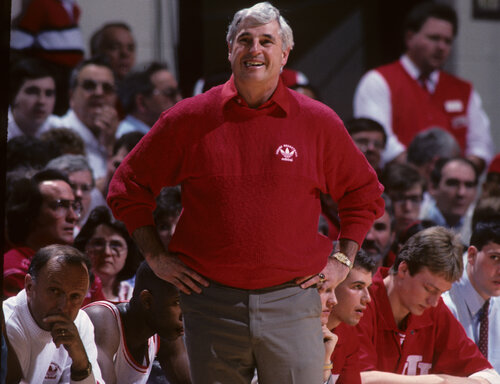
To follow those three tournaments game by game is to feel the sport change in real time—pace, spacing, competitive depth, and the names that rotate through March.
The full game-by-game bracket narratives of 1976, 1981, and 1987 are available inside the OUAT Sports Museum.
They do not reinterpret the era. They simply walk through the games—matchups, momentum swings, forgotten contributors, and the competitive texture of each March.
If you enjoy experiencing basketball as it was played, you can access them below.
CLICK HERE TO ACCESS THE KNIGHT TRIFECTA
Plus 30 other free downloads across the sports world
Around him, the regions take shape:
ACC: Dean Smith validates his already extraordinary career with the 1982 national title. Virginia’s Ralph Sampson becomes the sport’s defining early-1980s star. By mid-decade, a young Mike Krzyzewski has arrived at Duke and reached his first Final Four.
Big East: Georgetown reaches three Final Fours and wins the 1984 title behind Patrick Ewing. With that championship, John Thompson becomes the first black head coach to win a national title, and the Big East establishes itself as a new center of gravity in the sport. The league’s moment crystallizes in 1985 with three teams in the Final Four and Villanova’s improbable title.
The Bluegrass Corridor: Kentucky wins the 1978 championship and returns to the Final Four in 1984, but Louisville becomes the era’s defining Southern program. Titles in 1980 and 1986, plus Final Fours in 1982 and 1983, earn Denny Crum the reputation as “Mr. March.” The 1983 Elite Eight win over Kentucky ignites a rivalry that had rarely played out on the floor.
Southwest / Independent Powers: Houston’s Phi Slama Jama, led by Akeem Olajuwon, overwhelm with athleticism, even as they fall just short. A more unlikely star emerges from Terre Haute—Larry Bird—while Danny Manning is already looming at Kansas, pointing towards the next chapter.
The West: As UCLA fades, the region loses its organizing force. No single Pac-10 power replaces it. The vacuum matters. In fact, the West’s best team isn’t even in the Pac-10—it’s UNLV.
The temporary fall of the West underscores the larger truth: no single program can fill the space Wooden once occupied.
By 1987, the tournament stands in its modern form.
Explore the Brackets Themselves
1976 — The last unbeaten champion
1981 — Surviving the first great wave of chaos
1987 — Culmination in a fully modern field
Game by game. No reinterpretation. Just basketball.